

How to choose custom software development services
What custom software development services include, how discovery reveals a real partner, the engagement models, and the questions to ask before you sign.
 Articles
On this page16 sections
- What custom software development services include
- Why the discovery phase reveals everything about a partner
- What a real partner shows you in discovery
- A discovery maturity scorecard
- Engagement models, matched to your actual project
- Team structure: what a real delivery partner puts in the room
- What delivery looks like when a partner owns it
- Stability under pressure
- Reliability and release speed
- Infrastructure cost
- Quality and delivery accountability, built into the engagement
- What projects cost and how long they take
- How to evaluate and shortlist vendors before signing
- Red flags when choosing a development partner
- The questions to ask before you hire
- The bottom line
The clearest signal of a good development partner shows up before any code is written: in how they run the first conversation.
The best way to choose custom software development services is to judge how a vendor runs the first conversation: whether they map your requirements and scope the work before quoting a price, whether they show you the team who will actually build, and whether they can prove past results rather than describe them. This guide turns that into a process you can run before you sign.
This guide walks through the five areas where that discipline shows up: the discovery phase, the engagement model, the team structure, how quality and delivery accountability are built in, and how to evaluate and contract a vendor before you sign. It is written for founders, product owners, and technical leads who need to shortlist a real development partner, not collect proposals that all look the same.
What custom software development services include
Custom software development services are professional services that design, build, test, and maintain software shaped around a specific organization's needs, rather than a ready-made product bought off the shelf. A typical engagement can cover discovery and scoping, product design, frontend and backend development, API and system integration, QA, and post-launch support, delivered by a team assembled around the project rather than a fixed package.
The difference from off-the-shelf software is fit and ownership. Packaged products are faster to adopt and cheaper upfront, but you bend your process to the tool. Custom software fits your process, integrates with the systems you already run, and stays yours to extend. That is why companies choose to build when a workflow is central to how they compete and no off-the-shelf product matches it closely enough. The trade-off is that a custom build depends entirely on the partner you choose, which is why the rest of this guide is about how to choose well.
Why the discovery phase reveals everything about a partner
The discovery phase is the most reliable signal of a trustworthy custom software development company. A serious firm will not recommend a team structure or quote a price without first running requirements gathering, business-process analysis, feature prioritization, risk identification, and a formal scope definition. The output is a roadmap, a statement of work, and a set of deliverables you have signed off on before anyone starts building. That is not a formality. It is how misaligned expectations get caught while they are still cheap to fix, instead of becoming expensive change orders later.
When a vendor sends a full proposal within a day or two of a first call, they are pricing a project they do not understand yet. The warning signs are consistent: vague scope documents, one-size-fits-all team structures, and pricing that ignores integration complexity. A thorough discovery phase protects you as much as it protects the vendor. Any firm that skips it is transferring that risk directly to you.
This is where a discovery-first partner separates itself. When discovery leads every engagement, the recommendation on team size, timeline, and approach comes out of your actual context, not a template. That is the model to look for across every vendor you evaluate.
What a real partner shows you in discovery
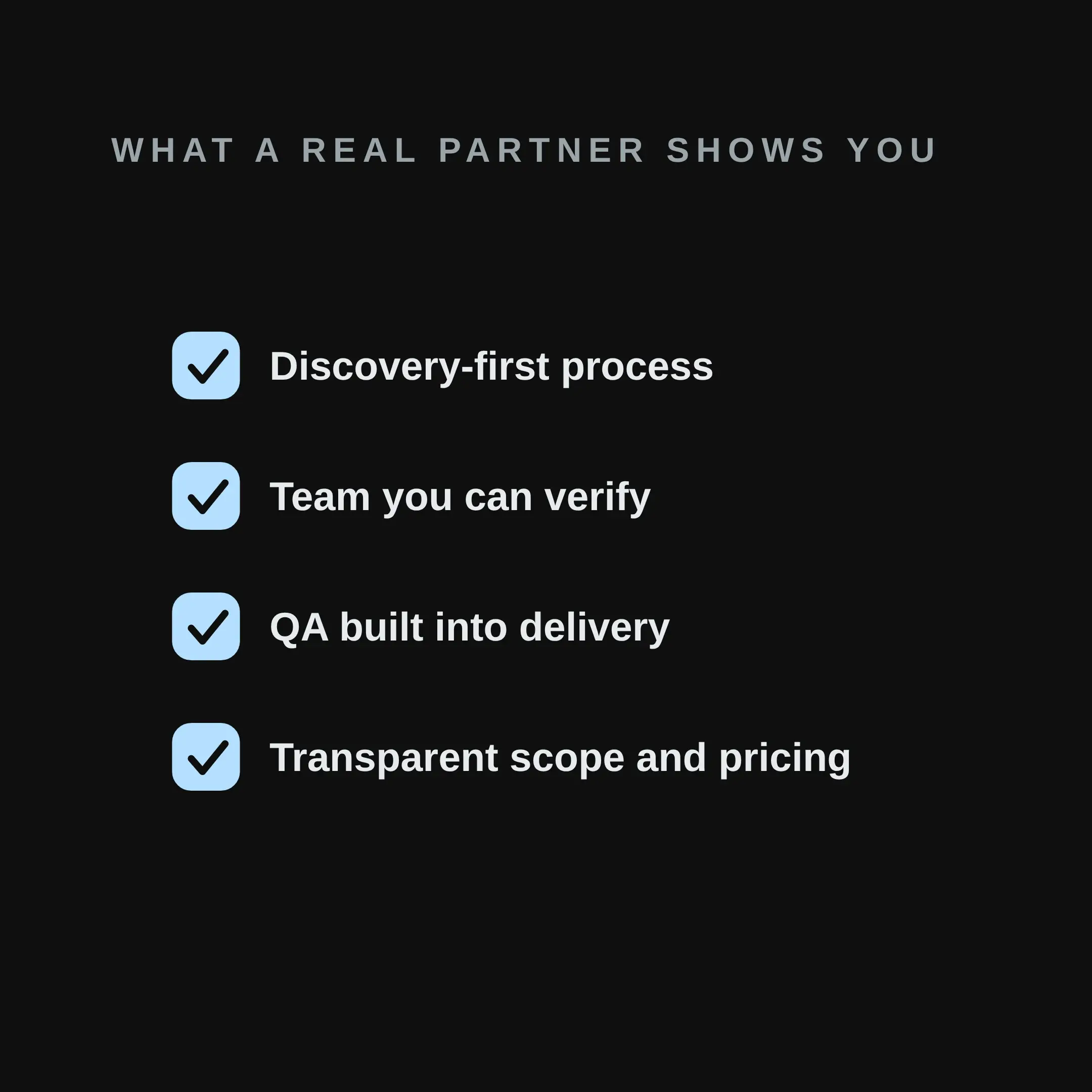
Discovery is where a real partner separates itself from a good sales process, because it produces artifacts you can inspect before any code is written. This is not a claim we make in the abstract. NetForemost runs a structured discovery on every engagement that aligns goals, risks, ownership, success criteria, and technical assumptions before a statement of work exists, and converts the output into a signed delivery plan. When you evaluate any vendor, ask to see anonymized versions of what their discovery actually produces. Four outputs tell you most of what you need to know.
- A prioritized scope, not a feature dump. A real partner turns "everything is important" into a defensible order and can explain why item one comes before item two.
- A statement of work tied to milestones and acceptance criteria, so "done" is defined before the build, not argued after it.
- A named team you can verify. The engineers on the project are the ones you met, not junior developers swapped in after signing.
- A risk log. The blockers, dependencies, and assumptions surfaced early, while they are still cheap to resolve.
If a vendor cannot show you these before the engagement starts, they are asking you to take scope, team, and risk on faith. A discovery-first partner has already produced them for every project, so there is nothing to invent on the call.
A discovery maturity scorecard
Most partner checklists score the vendor's pitch. This scores the one thing that predicts the rest: how seriously they run discovery. Rate each shortlisted vendor on the five signals below, weight the results, and you get a single number that tells you whether discovery is a real phase or a formality before the invoice.
- Scope definition (25%). Weak: a feature list copied from your brief. Average: some prioritization. Strong: a defensible order with the reasoning behind item one.
- Requirements and process analysis (20%). Weak: takes your requirements as given. Average: asks clarifying questions. Strong: maps your business process and surfaces what you did not think to specify.
- Statement of work (20%). Weak: a lump-sum quote. Average: phases with rough estimates. Strong: milestones tied to acceptance criteria you sign off on.
- Risk and dependency surfacing (20%). Weak: risks come up during the build. Average: a generic risk list. Strong: risks, dependencies, and assumptions documented before pricing.
- Team and ownership clarity (15%). Weak: "our team handles it." Average: roles named at kickoff. Strong: named engineers you can verify, and IP ownership stated in writing.
How to score it: rate each signal weak (1), average (3), or strong (5). Multiply each score by its weight, add the results, and multiply by 20 for a total from 20 to 100. Use these ranges as a practical benchmark when comparing vendors: 85 to 100, a discovery-first partner; 70 to 84, a capable vendor worth a paid pilot; 50 to 69, a build shop that will scope as it goes; below 50, a vendor pricing a project they do not understand yet. The weighting puts scope and requirements first, because a vendor who cannot define what you are building will not reliably deliver it, no matter how strong the rest of the pitch sounds.
Engagement models, matched to your actual project
Structure matters as much as rate, and it usually comes down to matching the engagement model to how well-defined your project is.
A fixed-scope engagement covers a defined set of deliverables, a locked timeline, and a budget tied to milestones and acceptance criteria. This model works when you can articulate exactly what "done" looks like: a well-defined MVP, a discrete feature build, or a bounded integration. The risk in fixed-scope work is scope ambiguity at the start. Any requirement not nailed down in the statement of work becomes a change-order conversation later, which is why the discovery phase matters so much before this model is chosen.
A dedicated team engagement is a stable, assembled team that works alongside your internal stakeholders over multiple quarters. This fits companies expanding a product roadmap, organizations with ongoing modernization needs, and teams adding development capacity without the overhead of full-time hires. The team stays attached long enough to build domain knowledge, which matters more than most buyers expect on a long roadmap. Accountability in this model has to be structural, not assumed: sprint coordination you can see, risk logs that surface blockers before they become missed deadlines, and delivery updates that arrive proactively rather than in response to your follow-up emails. If you are chasing the vendor for status, the accountability structure is not there.
Staff augmentation fits a different need: a short-term capacity gap or a specialist skill your team is missing, where senior engineers embed into your existing team rather than run a project end to end. You can read more about how these compare across staff augmentation, project-based delivery, and dedicated team models. Match the model to your release cadence and ownership needs, not just this quarter's budget.
Team structure: what a real delivery partner puts in the room
A structured partner assembles roles to match the project, not a generic headcount. For most builds, that includes backend developers covering APIs and system integrations, frontend engineers paired to the backend stack, QA engineers embedded in the sprint cycle, a tech lead or solution architect, DevOps or cloud engineers for infrastructure, and a project manager who owns delivery visibility. The mix changes by project type. An MVP needs a smaller, senior-heavy team, while an enterprise system needs parallel workstreams with specialist roles.
Firms with deep experience in a specific ecosystem can assemble these roles with proven patterns, instead of spending the first month figuring out the stack. The tooling decisions are repeatable, the integration patterns are familiar, and the team starts contributing sooner. That is a meaningful advantage over generalist shops stitching together developers from different contexts.
There is one question every buyer should ask directly, because it exposes how a vendor really operates: "Will the engineers assigned to my project be your direct employees, and can I review their profiles before the engagement starts?" A confident answer includes a yes and a path to those profiles. A deflected answer, something about a partner network or vetted resources, is a signal to keep looking. Subcontracted teams introduce a communication layer you cannot see, and seniority you cannot verify the same way.
What delivery looks like when a partner owns it
Criteria matter most when you can see them applied. These are anonymized results from real NetForemost engagements, each showing a baseline, what changed, and the outcome.
Stability under pressure
On one Android product, a focused stability effort cut the user-perceived crash rate from 0.54% to 0.36% (about 33%) and the ANR rate from 0.84% to 0.26% (about 69%), by prioritizing the highest-impact problems and validating fixes before release.
Read the Android stability case study
Reliability and release speed
On an API platform, a manual regression process meant a six-week release cadence and recurring production errors. Building automated tests into the CI pipeline prevented about 75% of previously recurring production bugs and moved releases to every two weeks.
Infrastructure cost
On another engagement, a cloud optimization effort reduced monthly AWS spend by about 18%, over $3,000 per month, without replatforming and without interrupting operations.
The Android and cloud results are published as full anonymized case studies you can inspect, linked above. The API result comes from a delivery engagement in our portfolio. None of these needed the client's name to be convincing: a partner who can point to a baseline, a method, and a measurable result is showing you the work behind the claim. A partner who cannot is asking you to trust the pitch.
Quality and delivery accountability, built into the engagement
Quality assurance and project management should be structural components of every engagement, not optional line items. When they are optional, they are the first things cut in a budget conversation, and that is exactly when a project starts to slip. The firms most likely to deliver on time are the ones where QA engineers are part of the sprint, not called in during the final week. A mature QA practice includes manual testing, regression testing, automation for repeatable scenarios, and release validation before any deployment. For any build, QA coverage is a deliverables question, not a budget question.
Meaningful project management looks different from what many development shops actually deliver. It means sprint planning you can observe, risk logs that surface blockers early, and status updates that arrive without prompting. Many shops assign project managers who are primarily coordinators, scheduling meetings and writing notes, rather than delivery owners who track progress against scope and flag drift before it becomes a missed deadline. The right question to ask is: "Who owns delivery accountability on your team, and how do we see that in real time?" Strong vendors answer with specifics.
This is the model NetForemost is built around. Discovery leads every engagement, teams are assembled by role to match the project, and QA and project management are part of delivery rather than bolted on after the fact. Quality is built into how the team works, not sold as a separate function.
What projects cost and how long they take
Cost and timeline are the questions every buyer wants answered first, and they are the ones no honest vendor can answer precisely without scoping the work. What custom software costs depends on three things: the size and complexity of what you are building, the seniority and location of the team, and how much integration, compliance, and data migration the project involves. Cost scales with project size: a focused MVP sits at the low end, a mid-size business application in the middle, and a complex enterprise system at the high end. Timelines follow the same logic, from a couple of months for a focused MVP to several months or more for an enterprise build. Any vendor who gives you a firm price or date before running discovery is guessing.
Region affects rate, but the lowest rate is rarely the real cost. Time-zone overlap, communication quality, and stack specialization move the true cost of a project more than the headline hourly figure. A nearshore team that overlaps with your business hours and knows your stack often delivers a lower total cost than a cheaper team that needs heavy management overhead and does not know the ecosystem.
Treat any cost or timeline a vendor gives you as a milestone-based range, not a calendar promise. A vendor who quotes a firm number for a mid-size application without running a discovery phase has not scoped the project. Use ranges as a sanity check when a proposal arrives that feels too fast, too vague, or too cheap.
How to evaluate and shortlist vendors before signing
Start with verified portfolio items and references from comparable projects, and ask for specific outcomes rather than a wall of logos. Then confirm demonstrated expertise in the stack you need, a documented delivery methodology, pricing tied to scope and milestones, a defined QA process, and clear post-launch support terms. A vendor's willingness to show you the actual profiles of the people who will work on your project is itself a signal of confidence. Stack-aligned firms tend to offer tighter accountability than generalist shops, because their tooling and integration decisions are repeatable and defensible. This model works best when the partner brings real specialization, not just available capacity.
The contract is where accountability becomes enforceable. A few clauses should be spelled out explicitly rather than implied. IP and source-code ownership should transfer to you on payment, in plain language. SLAs should define response and resolution times for support issues at each severity level. Security obligations should map to your regulatory environment, whether that is SOC 2, HIPAA, or PCI DSS. A change-control clause should define how scope changes are handled, what triggers a timeline or budget adjustment, and who approves it. And an exit clause should cover repository access, documentation handover, and transition assistance if the relationship ends.
Red flags when choosing a development partner
Some signals tell you a vendor is a sales process dressed up as a delivery partner. Watch for these:
- A full proposal and firm price within a day or two, before any discovery
- Scope documents that stay vague, and a one-size-fits-all team structure
- The people who pitch are not the people who will build, and profiles are not available before signing
- QA described as a final stage, not part of the sprint
- Every roadmap item treated as equally urgent, with no defensible order
- No measurable outcome they can show, even anonymized
- Deflection on who owns your source code and IP, or vague contract language on it
- No willingness to start with a bounded, paid first phase before a long commitment
The more of these you see, the more closely you should look at whether the partner can actually deliver, or only describe delivery.
The questions to ask before you hire
Use these with every shortlisted firm. They surface how a vendor actually operates, which is harder to fake than a polished pitch:
- What similar projects have you delivered, and what were the measurable outcomes?
- Who exactly will work on our project, and are they your direct employees?
- How do you handle QA and release readiness within a sprint cycle?
- What is your process when requirements change mid-project?
- What does post-launch support include, and what is your SLA?
- Do we own all source code and IP on payment, confirmed in writing?
- How do you run the discovery phase before committing to scope and price?
- Who owns delivery accountability on your team, and how do we see it in real time?
Strong vendors answer these directly and with specifics. Vague responses about flexible processes and collaborative approaches, without concrete examples, are a signal to keep looking. Accountable firms have already solved these problems internally, so they do not have to invent an answer on the call.
The bottom line
Choosing custom software development services is not about finding the cheapest vendor or the one with the most recognizable names on its homepage. It is about finding a partner whose process is visible before the engagement starts, whose team structure matches what your project actually needs, and whose QA and project management are built into delivery rather than added afterward.
So start with the discovery conversation. How a firm handles that first exchange tells you more about how it will run your project than any case study on its website. If you want a partner that leads with discovery, assembles teams by role, and builds QA and delivery visibility into every engagement, that is the model NetForemost is built around.
Before you sign, run the five checks that separate real capability from a polished pitch
Keep reading
All resources Articles
The bottleneck didn't disappear. It just changed its address.
AI made engineers faster — but throughput on the main branch is falling. Three tool launches in two weeks reveal where the bottleneck actually moved, and what it means for teams adopting AI coding agents.
 Guide
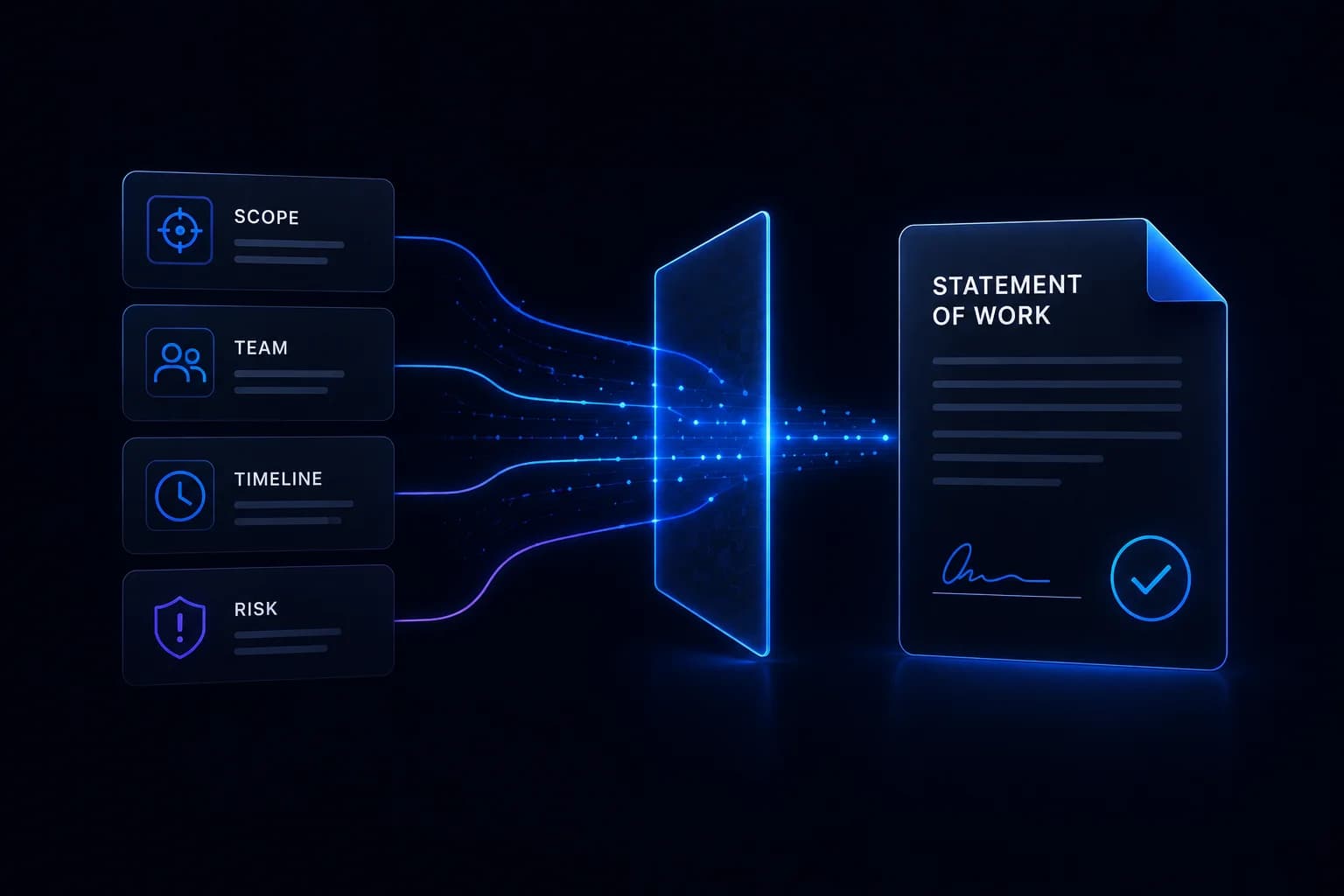
GuideDiscovery checklist: 24 questions before you sign a SOW
24 questions grouped into five areas, goals, risks, ownership, success criteria, and delivery assumptions, to align on before signing a statement of work.
 Articles
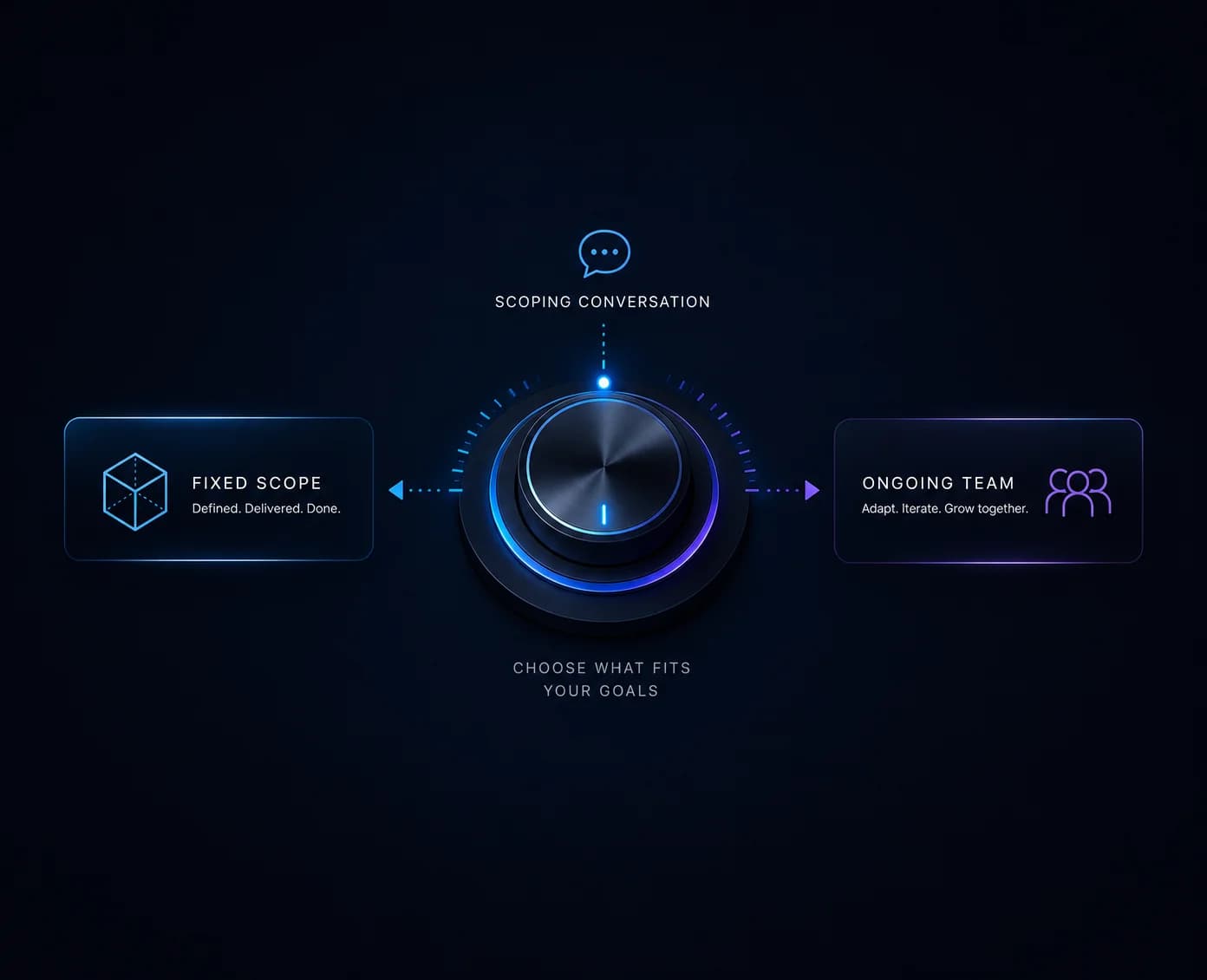
Fixed-scope or ongoing team? A scoping conversation that helps you choose
Four signals that tell you whether a fixed-scope engagement or an ongoing team fits your project, before you sign anything.