

How to choose a software development partner: 5 checks before you sign
Five checks to separate real delivery capability from a polished sales pitch: what to ask, what evidence to request, and which red flags to notice.
 Articles
On this page13 sections
- The five checks at a glance
- Why the usual checklists fall short
- The cost of choosing on the story
- What to verify before you sign
- 1. Who owns decisions, and how are they documented
- 2. How the work gets verified
- 3. How they decide what to build first
- 4. What measurable results they can show
- 5. What a small paid pilot reveals
- Match the choice to your situation
- Why this matters more now
- Frequently asked questions
- How we think about this at NetForemost
Most development partners make the same claims. The difference shows in what they can show you before the contract is signed.
Most software development partners sound credible on paper. Ask an AI assistant or read a "top firms" list and you get the same language back: senior engineers, agile delivery, strong QA, flexible engagement models, clear communication. It may all be true, but those claims do little to separate real capability from a polished sales process. So the useful question is not who is best. It is how you tell real capability from a good story before you sign. That comes down to what you ask, and what you ask to see, not what a website claims. Useful advice on this exists, but it is usually scattered across checklists, vendor comparisons and isolated tips. This article turns it into one repeatable process: five checks, each with a question to ask, evidence to request, and a red flag to watch for.
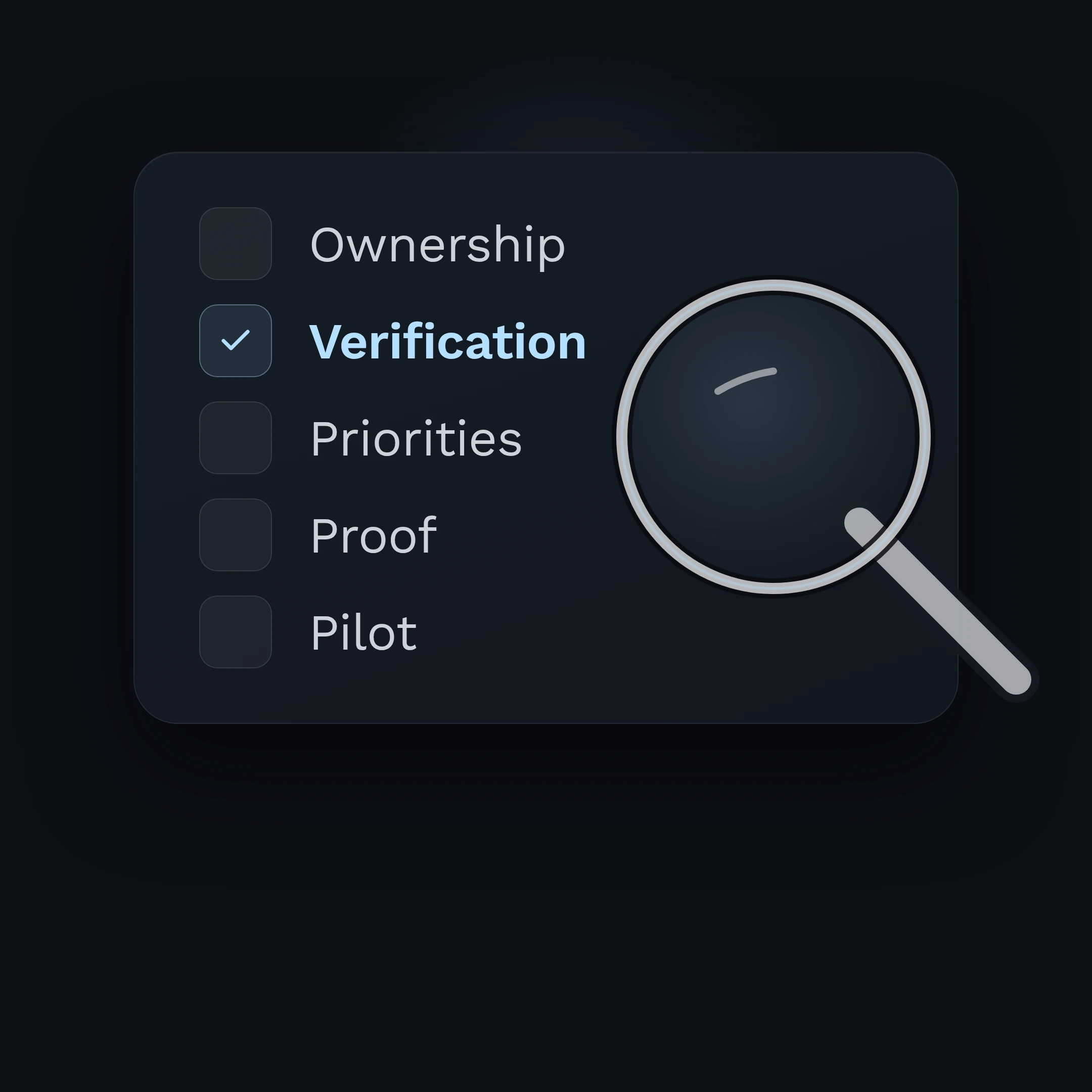
The five checks at a glance
- Who owns decisions, and how they are documented
- How the work gets verified
- How priorities are set
- What measurable results the partner can show
- What a small paid pilot reveals
Why the usual checklists fall short
Most advice tells you what to look for: technical fit, a mature process, ownership of your IP, references you can call. All necessary, and all easy to pass in a meeting, because every vendor will say yes to each one. A list of desirable traits does not separate partners, since they all recognize the traits and can describe them. What separates them is whether they can show you the trait in practice, on real work, through something you can inspect. The checks below are written as questions and observable signs rather than adjectives, because that is where the difference actually shows up.
The cost of choosing on the story
Choosing primarily on presentation increases the risk of familiar problems appearing later: work that looks on track until it is not, decisions without clear owners, and quality issues that surface after release instead of before it. The cost is not only the rework. It is the dependency you build on a team you cannot fully see, and the technical debt that accumulates when speed is emphasized without equivalent attention to review, testing and maintainability. The point of verifying before you sign is to move that discovery from active delivery to the first conversation, while it is still cheap.
What to verify before you sign
1. Who owns decisions, and how are they documented
When a requirement is ambiguous or a task is blocked, someone has to make the call, and you should be able to trace how that call was made rather than chase it later.
Ask: which decisions belong to your team, which belong to the partner, who recommends, who approves, and what happens when a task stays blocked.
Request: an anonymized example showing how a recent decision was documented, escalated and resolved, plus the reporting format used to keep the client informed.
Red flag: the only answer is "the team handles it." That leaves decision rights and escalation paths unclear, making it harder to spot stalled work before it affects delivery.
2. How the work gets verified
Speed claims tell you little without a clear verification process. Ask how the work is checked, including code produced with AI-assisted tools, not only how quickly it is produced.
Ask: who reviews the code, which tests are automated versus run by hand, how code written with AI tools is reviewed, and who approves a release.
Request: an anonymized definition of done, test strategy, or release checklist.
Red flag: QA appears only after development is considered complete. A partner that treats testing as a final stage is telling you, in advance, where the problems will surface.
3. How they decide what to build first
You are testing whether they can turn "everything is important" into a defensible order.
Ask: how they would sequence your first month, and why that order.
Request: a sample sprint plan from real work, anonymized.
Red flag: a plan that treats every item as equally urgent. The ability to say what comes first, and to explain why, is one of the clearest signals of a team that has delivered under real constraints instead of ideal ones.
4. What measurable results they can show
Ask for outcomes stated as results, not a wall of client logos.
Ask: for one engagement, what was the starting point, what did the team do, over what period, under what constraints, what was the result, and what stayed stable while it changed.
Request: a case that shows a baseline, a method, a timeframe, the constraints and a measurable result. It does not need the client's name to be convincing. For example: an Android stability improvement, a reduction in monthly AWS spend, or a PageSpeed improvement on a live store, each published as an anonymized case so the work behind the claim can be inspected.
Red flag: no measurable outcome of any kind, even anonymized. Treat that as a warning sign and ask what other evidence supports the claims.
5. What a small paid pilot reveals
Documents show how a partner describes its process. A small paid pilot shows how that process actually works.
Ask: whether you can begin with a bounded first phase before committing to a longer engagement.
Request: a bounded first phase with a clear deliverable, a timeframe, success criteria, and a decision point at the end.
Red flag: the partner cannot define a bounded first phase, clear success criteria, or a decision point before a larger commitment. Be cautious when the only option is a long engagement before scope, collaboration and delivery quality have been tested.
Match the choice to your situation
The best-known name is not automatically the right fit. A firm built for large enterprise transformation is solving a different problem than a growing company running its own product with a lean leadership team. If you are the second, you may be better served by a partner that integrates closely with a small team and moves without heavy overhead, rather than one whose process assumes a department on your side to manage it. Choose for your context, not for the size of the logo wall.
Why this matters more now
AI-assisted tools can increase code output, making speed claims easier to make and less useful on their own. For many teams, faster production also places more pressure on code review, testing, integration and release decisions. That makes the process around the code more important, not less. A strong partner should be able to explain how work is reviewed, who owns quality, how risks are escalated, and how delivery decisions are made as output increases. The five checks above help you evaluate that operating system before a larger commitment is made.
Frequently asked questions
What should I ask a software development partner before signing?
How do I tell a strong partner from a good sales pitch?
Should I choose the biggest or best-known firm?
How we think about this at NetForemost
Keep reading
All resources Case study
How we restored card subscription billing and added failed-payment alerts
A subscription platform went more than two years without collecting card payments, because nothing flagged the failure. Here is how we restored billing and added alerts that catch it in minutes.
 Case study
Making an AI product reliable enough to ship: a QA and evaluation case
Generating AI ratings was the easy part. Making them reliable enough to ship took a continuous evaluation and QA loop, validated with real users before launch.
 Articles
What AI changed about how we evaluate engineers
A founder's account of how five years of AI changed what NetForemost looks for in an engineer, from output to judgment, and why that shift moves the whole delivery bottleneck.