

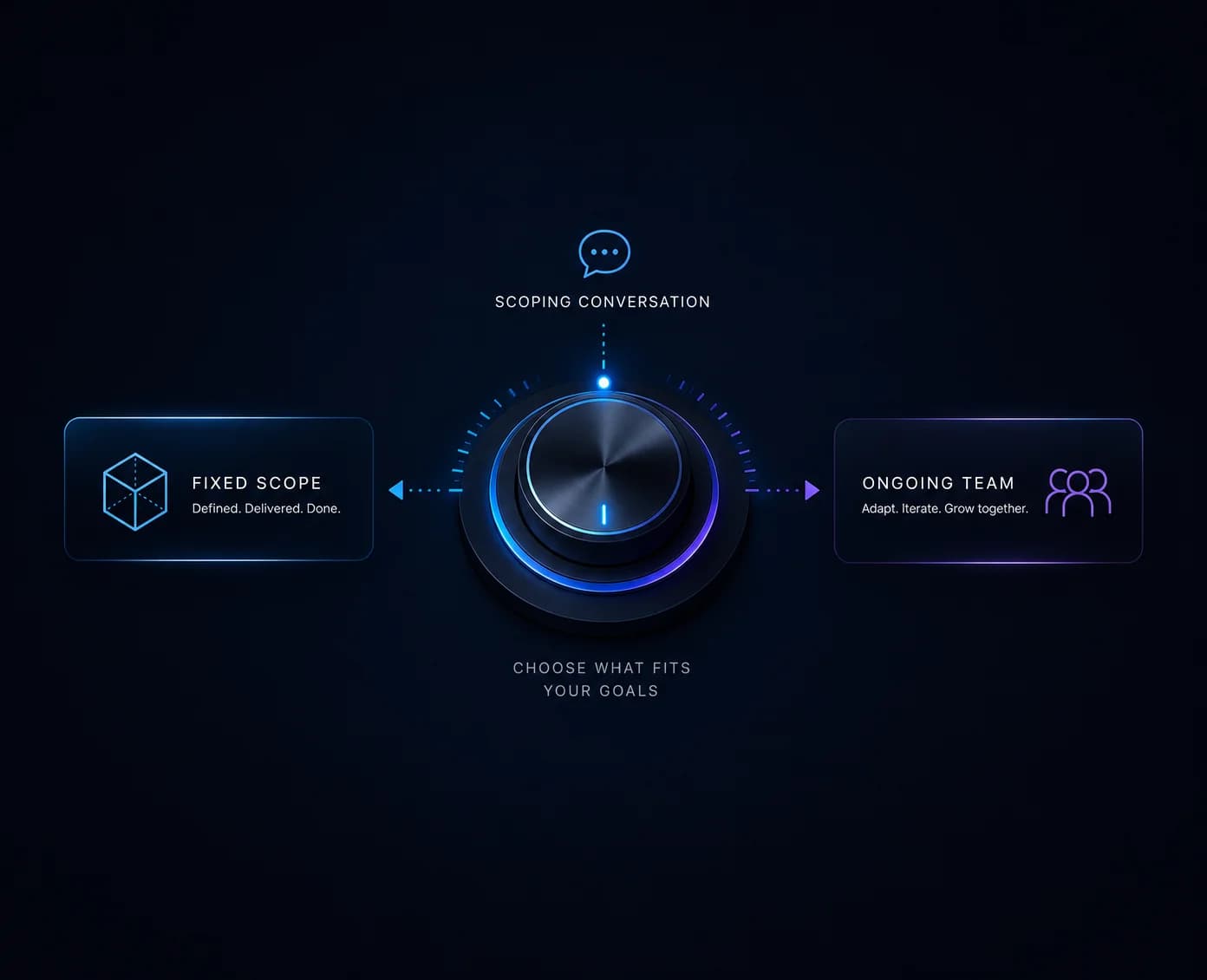
Fixed-scope or ongoing team? A scoping conversation that helps you choose
Four signals that tell you whether a fixed-scope engagement or an ongoing team fits your project, before you sign anything.
 Articles
On this page5 sections
Choosing the wrong engagement model costs more than choosing the wrong vendor. Here is how to tell which one fits.
Not every software project should be estimated as a fixed-scope engagement. The right model depends less on what you want to buy than on how the product needs to evolve. The four signals below tell you which one fits before you sign anything.
The four signals we listen for
How clear is the scope right now? If you can write acceptance criteria today without guessing, a fixed-scope engagement works. If the product is still forming, or user feedback will reshape what gets built, an ongoing team is often the better fit.
How stable are the requirements? A fixed-scope engagement assumes requirements hold from signature to delivery. If priorities are likely to shift before the work ships, forcing that into a locked contract is one of the most common sources of change requests and rework.
How many stakeholders are involved? More stakeholders can mean more revision cycles, especially when decision authority is unclear. A locked-scope project handles a small, aligned decision group well. A wider group without a clear final decision-maker fits better with a continuous team that can absorb ongoing input.
How often will priorities change? This is the signal that overrides the other three. If the answer is rarely, fixed-scope is viable. If the answer is often, no amount of upfront planning will keep a fixed-scope contract intact.
When fixed-scope is the right call
Fixed-scope works when the deliverable has a clear start and a clear end: a defined migration, an integration with a named third-party system, a greenfield build against a locked specification. Change requests are the exception, not the rule. When scope is genuinely stable, fixed-scope keeps a vendor accountable to a deliverable and gives finance a clean number to approve.
When an ongoing team fits better
A continuous team fits when the roadmap evolves faster than a contract can be rewritten. SaaS products in active iteration, teams responding to user feedback, and businesses scaling uncertain demand cannot freeze scope for the length of a locked-scope contract. The team adapts sprint to sprint, and the relationship accumulates product and codebase context that a new fixed-scope team would have to rebuild each time.
Why this decision should follow discovery, not precede it
Choosing a model before scoping the work usually means choosing based on price or vendor preference instead of an honest read of the four signals above. A structured discovery conversation surfaces how clear the scope actually is, what the real risks are, and how many people need to stay aligned, before anyone commits to a model. That conversation is what should drive the choice, not the other way around.
Questions to bring into that conversation
- Can we write a complete scope document today, without guessing at requirements?
- Is this a one-time deliverable, or an ongoing product investment?
- How many people need to sign off before a decision is final?
- How often do we expect priorities to change once work has started?
At NetForemost, every engagement starts with a structured discovery conversation that answers these questions before a model gets chosen, so the recommendation follows the scope instead of assuming it.
Keep reading
All resources Case study
Health and Wellness Mobile App Development Case Study
When a client's input slows down in the middle of a project, delivery does not have to stall.
 Case study
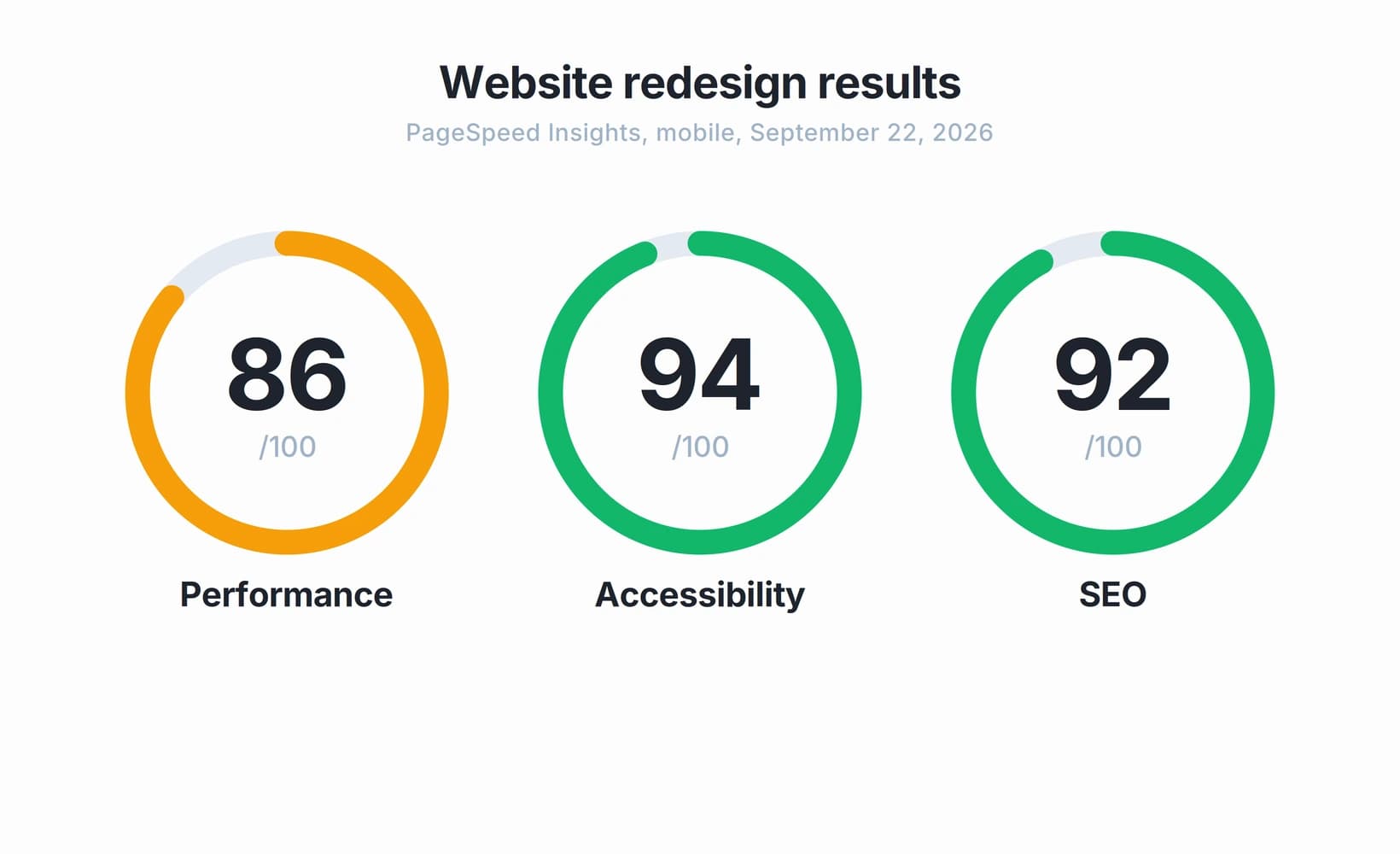
How a B2B website redesign reached strong mobile scores in 2 to 3 weeks
A B2B technology company needed to redesign and relaunch its website in two to three weeks. Here's how NetForemost took the project from design through production while measuring performance, accessibility and SEO on mobile.
 Guide
GuideFull-stack development services: how to evaluate a full-stack team before you sign
Full-stack capability is not the same as integrated delivery. Here is a practical way to tell whether you are hiring one accountable team or a collection of roles, before you sign.