

How a B2B website redesign reached strong mobile scores in 2 to 3 weeks
A B2B technology company needed to redesign and relaunch its website in two to three weeks. Here's how NetForemost took the project from design through production while measuring performance, accessibility and SEO on mobile.
 Case study
On this page10 sections
- Why did the company need a website redesign?
- How long does it take to redesign a website?
- What was the website redesign process?
- What results did the redesign achieve?
- What does a PageSpeed Insights score mean?
- What can you apply to your own website redesign?
- Website redesign FAQ
- How long does a website redesign take?
- Does a website redesign affect SEO?
- What is a good PageSpeed Insights score?
NetForemost handled this website redesign end to end, from design through validation to production launch, with performance, accessibility and SEO built into the work rather than treated as cleanup after the design was finished. The project ran in about two to three weeks.
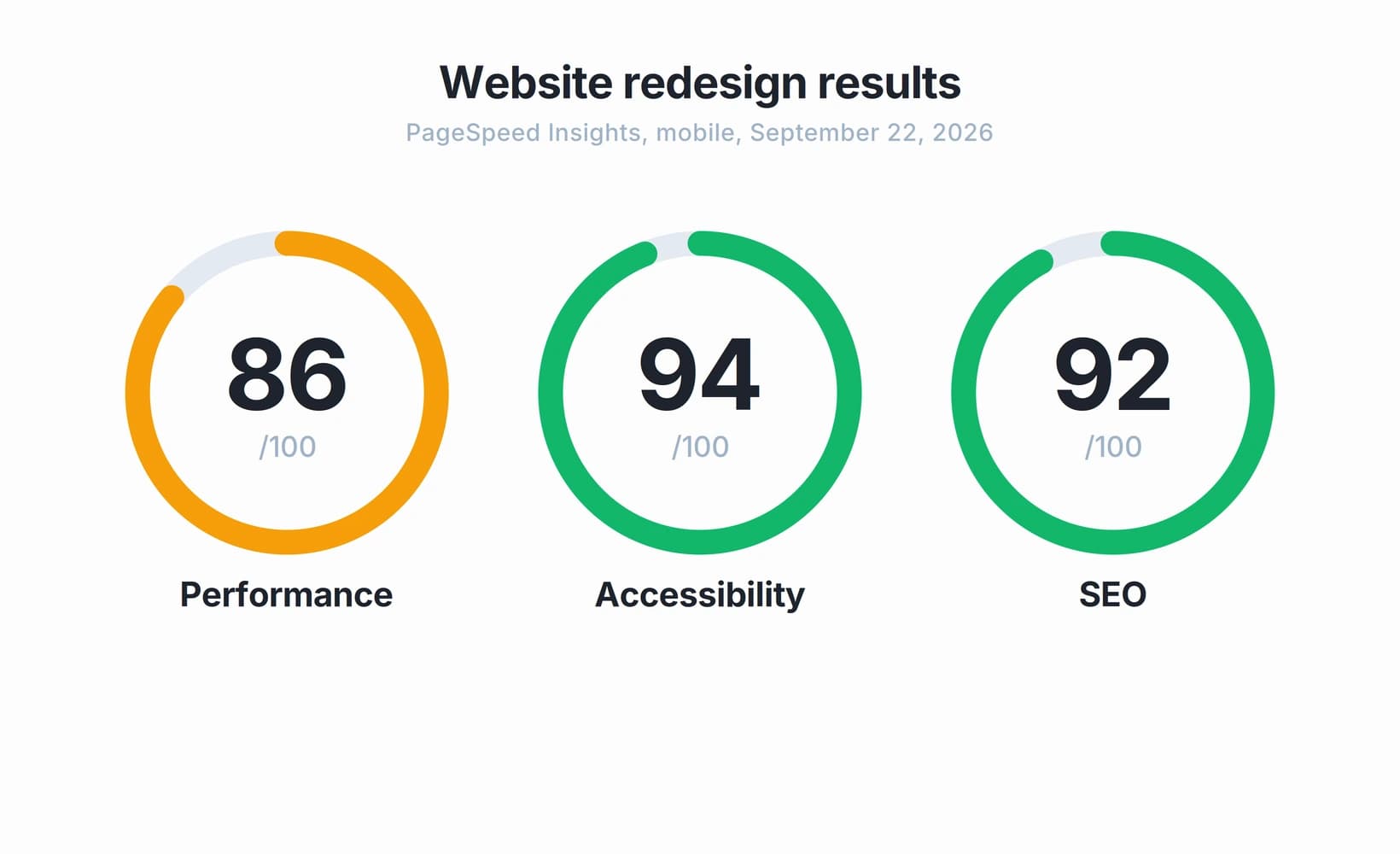
This website redesign case study covers how NetForemost took a B2B technology company's site from design to production in about two to three weeks. Performance, accessibility and SEO were built into the work from the start instead of being fixed after launch. On mobile, Google PageSpeed Insights scored the relaunched site 86 for performance, 94 for accessibility and 92 for SEO.
Why did the company need a website redesign?
The company needed a production-ready site live in about two to three weeks, with performance, accessibility and SEO validated during the build rather than after it. The constraint was time: the new version had to reach a high technical standard on a short timeline, without trading quality for speed.
How long does it take to redesign a website?
This redesign took about two to three weeks from design to production. Timelines depend mostly on the number of page templates, how much content changes, and whether design, development and QA run in parallel or wait on each other.
Here, one team handled design, frontend, performance, accessibility and QA together, so the work did not stall at handoffs. That overlap is the main reason a full redesign and relaunch fit into a few weeks.
What was the website redesign process?
The process ran as one design and development track with technical checks at every stage, rather than a sequence of separate handoffs. The work covered:
- Experience and interface design, redesigning how the site reads and flows, validated before build.
- Frontend implementation of the new version, built for a short timeline.
- Performance optimization, focused on fast mobile loading and a stable layout.
- Accessibility built into implementation, including contrast, keyboard navigation and semantic structure, checked during the build rather than after.
- Technical SEO basics such as metadata and heading structure, handled as part of the build.
- Quality validation before release.
- Production deployment and launch.
What results did the redesign achieve?
On mobile, PageSpeed Insights (September 22, 2026) scored the relaunched site 86 for performance, 94 for accessibility and 92 for SEO. Mobile is the stricter of the two PageSpeed profiles and the one Google uses for ranking, so these are the numbers that best reflect how most visitors experience the site.
Measured performance included a 0.7s First Contentful Paint, 0.8s Largest Contentful Paint, 40ms Total Blocking Time and 0.005 Cumulative Layout Shift.
What does a PageSpeed Insights score mean?
PageSpeed Insights scores from 0 to 100, where 90 to 100 is good, 50 to 89 needs improvement and below 50 is poor. A high performance score means the page loads its main content fast, responds quickly to input and does not shift around while loading. These are lab measurements from a test run, so real-visitor data can differ with device and connection. The SEO score checks technical basics like metadata and crawlability; it does not measure rankings or traffic. Mobile scores are usually lower than desktop for the same page.
What can you apply to your own website redesign?
In this project, UI/UX, performance, accessibility and SEO were handled as one design and development process, not as separate handoffs. Three things made the short timeline work:
- Set performance and accessibility targets before design starts, not after launch.
- Run design, development and QA as one team so a short timeline does not create rework.
- Measure with the same tool and device profile each time so the results stay comparable.
Website redesign FAQ
How long does a website redesign take?
This one took two to three weeks from design to production. The biggest factors are the number of templates, how much content changes, and whether design, development and QA overlap.
Does a website redesign affect SEO?
It can. Changed URLs, lost metadata or slower pages can cost rankings. Keeping metadata intact, checking that links resolve correctly and validating performance before launch all reduce that risk.
What is a good PageSpeed Insights score?
90 to 100 is good, 50 to 89 needs improvement, and below 50 is poor. Mobile scores are usually lower than desktop for the same page, so it helps to state which profile a score comes from.
Keep reading
All resources Case study
Making an AI product reliable enough to ship: a QA and evaluation case
Generating AI ratings was the easy part. Making them reliable enough to ship took a continuous evaluation and QA loop, validated with real users before launch.
 Articles
What AI changed about how we evaluate engineers
A founder's account of how five years of AI changed what NetForemost looks for in an engineer, from output to judgment, and why that shift moves the whole delivery bottleneck.
 Case study
Mobile app onboarding redesign case study
An instrumented onboarding rebuild lifted a mobile app's sign-up completion from 48 to 70 per 100, and the same measurement showed where the real bottleneck was.