

How to find a web development agency that actually fixes site speed (2026 buyer's guide)
Choosing an agency that fixes performance in your codebase using real-user field data — not one that installs a caching plugin and reports a laboratory score — is the difference between a store that converts better and an invoice your customers never feel.
 Guide
GuideOn this page14 sections
- Why site speed is a revenue problem, not a technical one
- The two tests that separate real engineering from plugin work
- Test 1: field data or lab scores?
- Test 2: code fixes or plugin installs?
- Seven questions to ask before signing
- Red flags
- What it should cost and how long it takes
- Why speed is a system, not a task
- Frequently asked questions
- What is a good Core Web Vitals score?
- Do Core Web Vitals affect Google rankings?
- Can a plugin fix my Core Web Vitals?
- How long until I see results?
- Should I hire a specialist or a full-service team?
If you are looking for a web development agency that specializes in site speed optimization, the short answer is this: choose one that fixes performance in your codebase using real-user field data, not one that installs a caching plugin and reports a laboratory score. The difference between those two approaches is the difference between a store that converts better and an invoice for work your customers never feel.
This guide explains how to tell them apart, what to ask before signing, what the work should cost, and the warning signs that an agency is selling scores instead of outcomes.
Why site speed is a revenue problem, not a technical one
Shopify's own analysis of its commerce ecosystem found that every 100ms of extra load time is associated with roughly 3.5% lower conversion, and that stores with a 2.5-second LCP convert measurably worse than stores at 1.5 seconds. Google's research adds that 53% of mobile visitors abandon pages that take longer than 3 seconds to load.
For an ecommerce brand, that places site speed directly between your marketing spend and your revenue: every dollar spent driving traffic to a slow store is a dollar working against friction. That is why choosing who fixes it deserves the same rigor as choosing who runs your ads.
The two tests that separate real engineering from plugin work
Test 1: field data or lab scores?
There are two ways to measure speed. Lab data (Lighthouse, PageSpeed Insights scores) comes from a simulated test under controlled conditions. Field data (Google's Chrome UX Report, or CrUX) comes from your real visitors over the previous 28 days — and it is the data Google actually uses for the Core Web Vitals ranking signal.
An agency doing real performance work will baseline your CrUX field data first and talk in its terms: LCP under 2.5 seconds, INP under 200 milliseconds, CLS under 0.1, measured at the 75th percentile of real sessions. An agency chasing lab scores will show you a before-and-after Lighthouse screenshot. Those scores can improve while your actual customers feel nothing.
Test 2: code fixes or plugin installs?
Caching and optimization plugins have a place, but they work around problems rather than fixing them. They cannot repair a layout shift caused by your ad slots, an interaction delay caused by heavy JavaScript, or a slow LCP caused by how your hero image loads. Those require changes in the code — ideally delivered as reviewable pull requests your team can inspect, so the work is transparent and survives the engagement.
Ask where the fixes will live. If the answer is "in our plugin configuration," the improvements leave when the plugin does.
Seven questions to ask before signing
- Will you baseline my Core Web Vitals using CrUX field data, and share that baseline with me before quoting?
- Which specific metric is failing on my store today — LCP, INP, or CLS — and what is the likely root cause?
- Will fixes be delivered as code changes my team can review, or as plugin configuration?
- How do you prevent regressions after the engagement ends — monitoring, alerts, performance budgets?
- Can I see field data (not launch-day screenshots) from a past client, showing performance sustained over months?
- Who works on this — one developer, or do design, development, and QA review each other's changes?
- What happens if the audit shows my problem is small? Will you scope down, or does every client get the same package?
The last question matters more than it looks. An honest agency will sometimes tell you the fix is a week of focused work, not a rebuild. If every prospect needs the full package, the diagnosis was never real.
Red flags
- Guaranteed scores on a fixed timeline ("95+ PageSpeed in 48 hours"). Scores can be gamed; field data cannot be rushed — it aggregates 28 days of real visits.
- A quote before an audit. If they can price the work without looking at your data, the price was never about your work.
- "Best agencies" listicles where the publisher ranks itself first. Several of the most-cited articles for this exact search do this — treat them as advertising, not advice.
- Results expressed only in Lighthouse points, never in conversion, bounce, or revenue terms.
- No mention of who maintains speed after launch. Performance decays as features, scripts, and campaigns accumulate; a fix without a maintenance plan is temporary by design.
What it should cost and how long it takes
Published pricing across specialist agencies gives an honest range. A standalone performance audit typically runs a few hundred dollars (roughly $300–600) and takes one to two weeks. A focused optimization engagement — audit plus code-level fixes — commonly lands between $1,500 and $5,000 depending on platform and complexity. Larger builds where performance is architected in from the start run well beyond that.
Timelines follow the physics of field data: code fixes ship in days or weeks, but CrUX aggregates a rolling 28-day window, so proof of improvement in the data Google uses takes about a month to fully register. Any promise faster than that is a promise about lab scores.
Why speed is a system, not a task
Here is what most guides — and most agencies — miss: the store that got slow did not get slow by accident. A designer added a heavier hero. A developer shipped a feature with an unreviewed script. A marketing tag went in without QA. Speed decays at the seams between disciplines, which is why fixing it as an isolated technical task rarely holds.
This is how we approach it at NetForemost: design, development, and QA working as one system, with clear visibility into what is being fixed, why, and what it changes. If you want to know where your store actually stands, we offer a free Core Web Vitals check — you get your field-data baseline and the first priorities, whether or not you work with us. Request it at netforemost.com.
Frequently asked questions
What is a good Core Web Vitals score?
Google's "good" thresholds are LCP under 2.5 seconds, INP under 200 milliseconds, and CLS under 0.1, measured at the 75th percentile of real user sessions in CrUX field data.
Do Core Web Vitals affect Google rankings?
Yes — Google has confirmed Core Web Vitals as a ranking signal since 2021. The larger business case, however, is conversion: speed affects every visitor, not just the ones arriving from search.
Can a plugin fix my Core Web Vitals?
Plugins can help with caching and compression, but they cannot fix layout shift from ads, interaction delays from heavy JavaScript, or LCP problems rooted in how a page is built. Those require code changes.
How long until I see results?
Code fixes ship in days or weeks, but CrUX field data aggregates a rolling 28-day window, so improvements take roughly a month to fully register in the data Google uses.
Should I hire a specialist or a full-service team?
It depends on the diagnosis. If your issue is one failing metric with a clear root cause, focused work may be enough. If speed keeps regressing every time you ship, the problem is the system — and the fix needs design, development, and QA working together.
Keep reading
All resources Articles
What AI changed about how we evaluate engineers
A founder's account of how five years of AI changed what NetForemost looks for in an engineer, from output to judgment, and why that shift moves the whole delivery bottleneck.
 Case study
Health and Wellness Mobile App Development Case Study
When a client's input slows down in the middle of a project, delivery does not have to stall.
 Case study
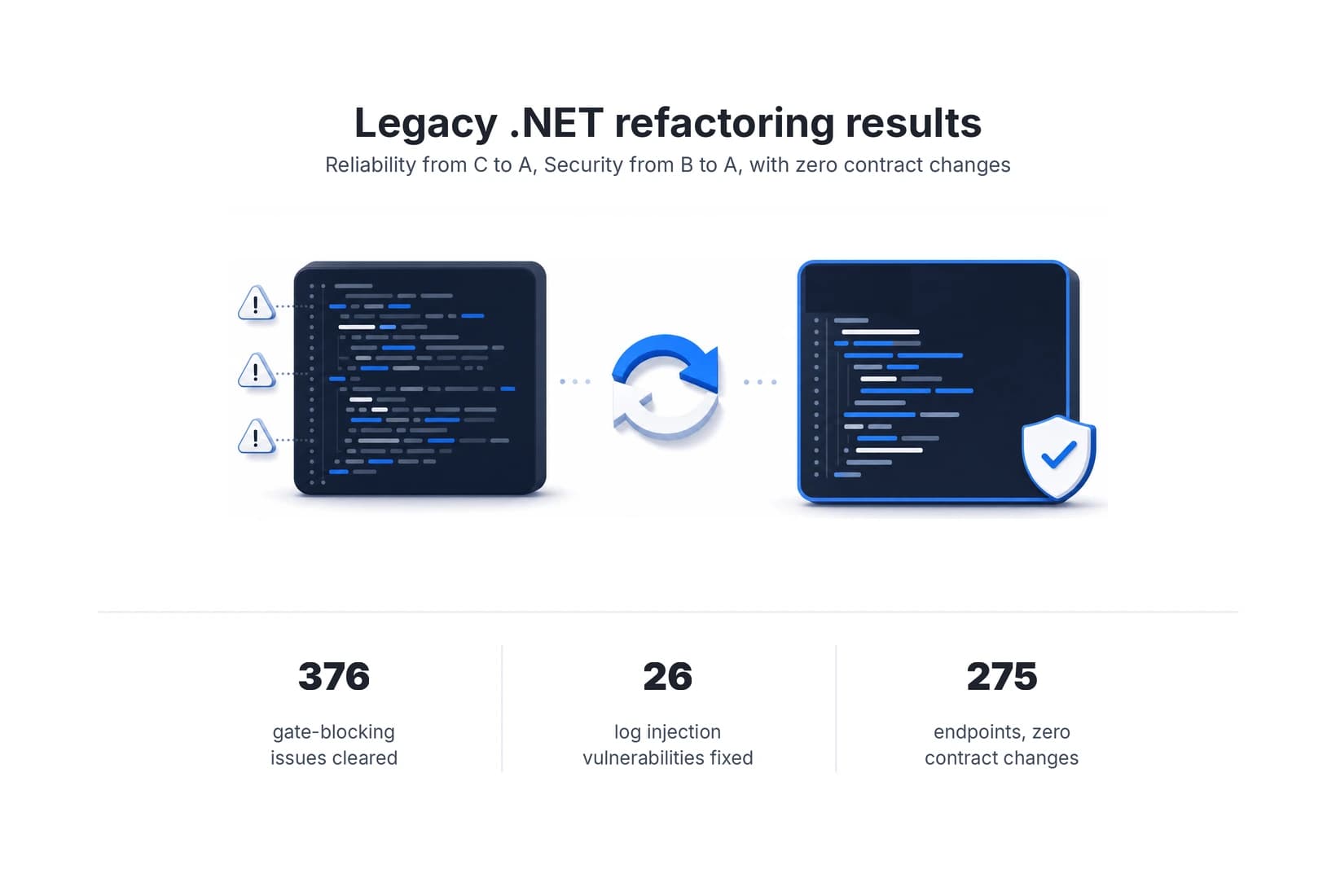
Legacy code refactoring on a live .NET 8 API, with zero contract changes
How AI-native development cleared a blocking SonarQube quality gate and 26 log injection vulnerabilities in a production .NET 8 API, with zero contract changes across all 275 endpoints.