

How we raised an online store's PageSpeed score from 31 to 54 in three days
An online store had gone years without meaningful performance work. Here's how a controlled, prioritized optimization raised its PageSpeed score by 23 points in three days.
 Case study
On this page4 sections
The store needed maintenance and had not received relevant performance optimization for several years. Over time, unoptimized assets, render-blocking resources, and third-party scripts and widgets had accumulated, adding weight to page loading and rendering.
Where it started
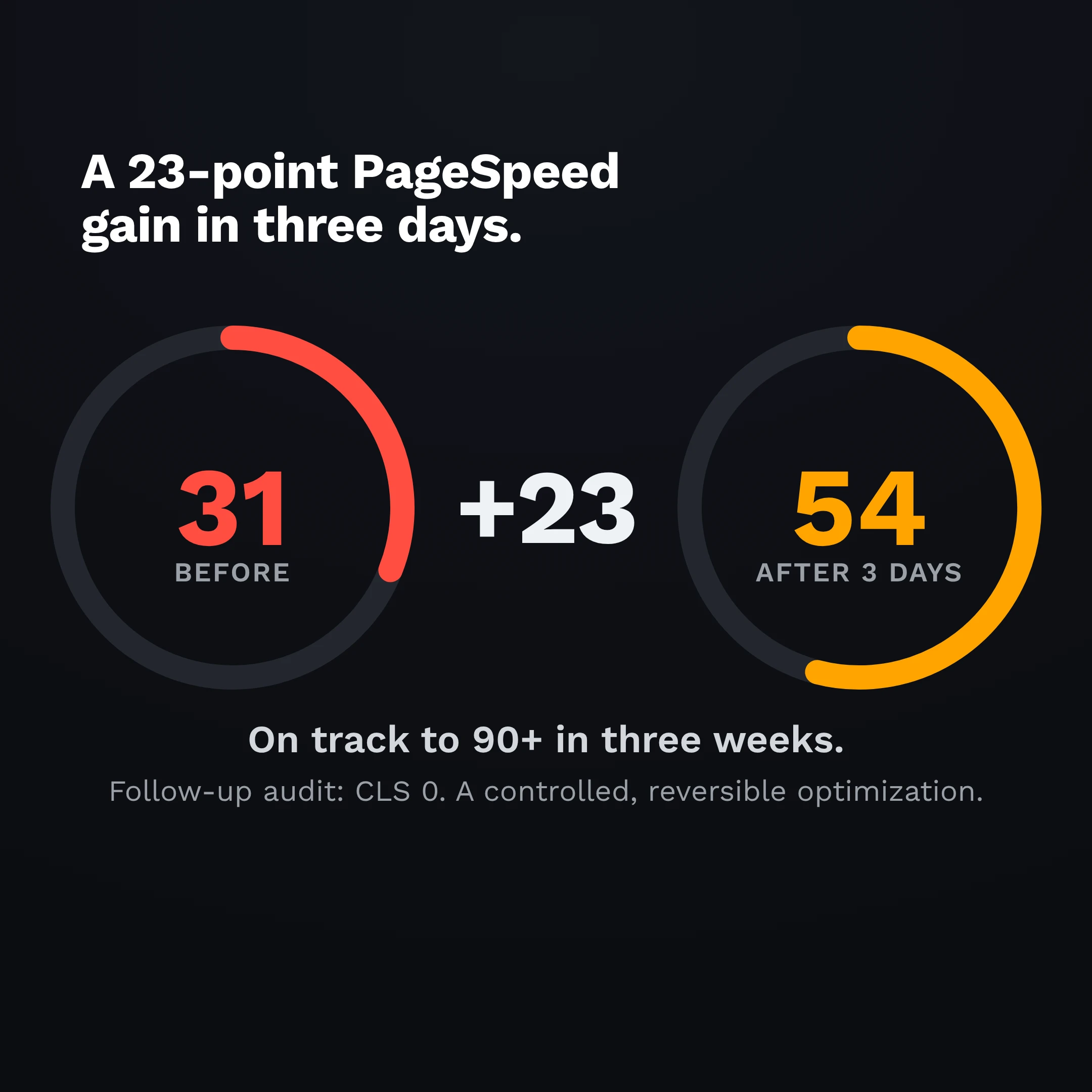
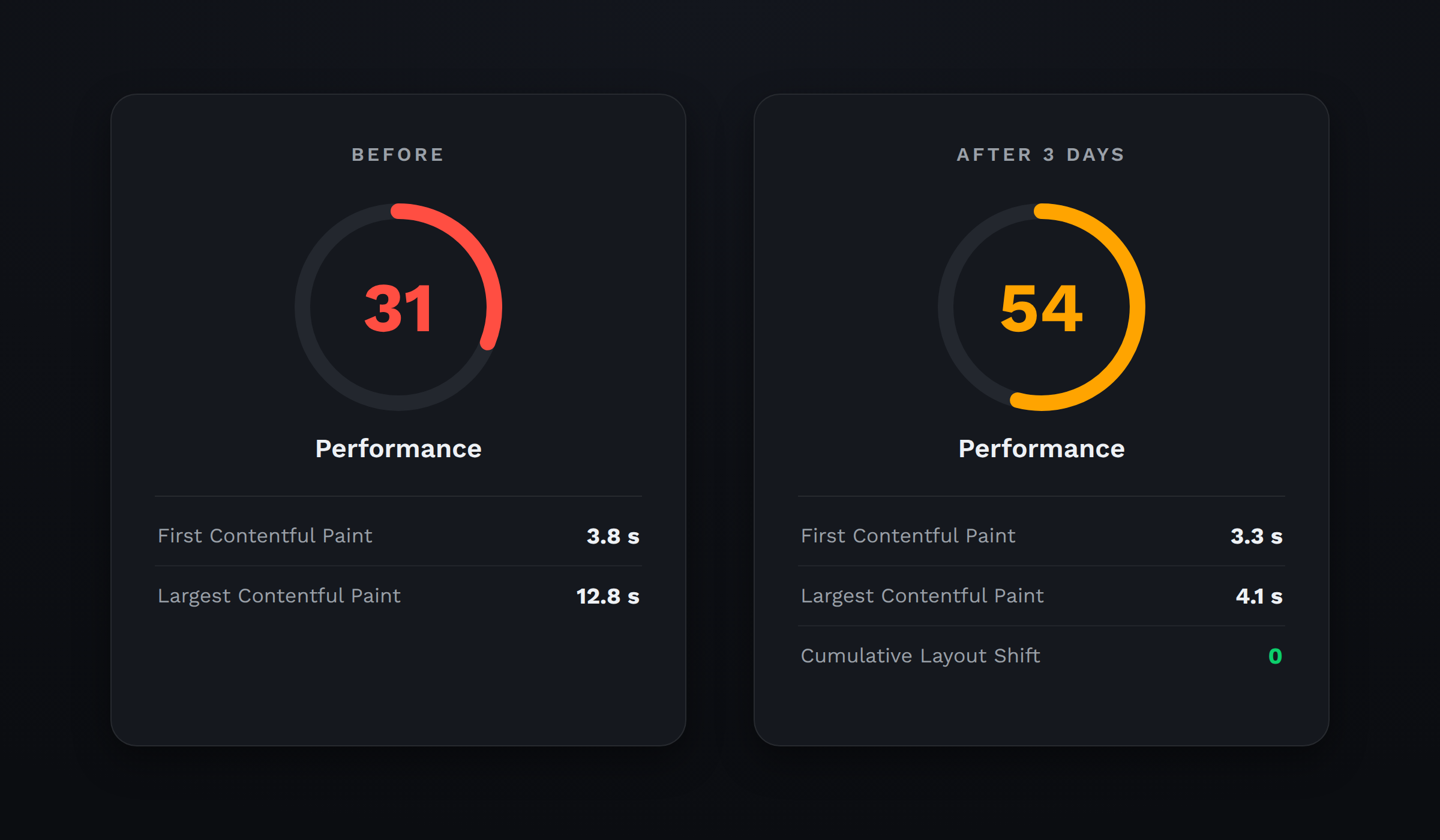
Before changing anything, the team established a baseline. The initial PageSpeed audit returned a performance score of 31, with clear performance issues across loading, rendering, and visual stability.
A result like this rarely reflects one isolated failure. It usually comes from multiple smaller constraints compounding, which is why the team prioritized the highest-impact opportunities without introducing unnecessary risk.
How NetForemost approached it
The work followed one principle: measure first, fix what matters most, and make every change in a traceable environment.
The team made every change safe and reversible from the start, with a full theme backup and a dedicated repository, and set a measured baseline before touching anything. From there it focused on the highest-impact fixes: improving the Largest Contentful Paint so content appeared faster, removing render-blocking resources, cleaning up JavaScript and CSS, and resolving the layout shifts that made the page jump as it loaded. Finally, it traced the hidden cost of third-party scripts and widgets, moving non-essential ones to conditional and lazy loading, and validated each pass to catch regressions.
The result
During the first three days of work, the store's PageSpeed performance score increased from 31 to 54, a 23-point gain. The follow-up audit also recorded a Cumulative Layout Shift of 0, while other metrics still showed room for further improvement.
The team is continuing the optimization work toward a PageSpeed target above 90 within three weeks.
This was not the end of the optimization work. It was an early, measurable improvement and a stronger technical foundation for the next round of changes.
The takeaway
Performance problems usually accumulate through many smaller constraints rather than one isolated failure. A progressive approach, starting with measurement, prioritizing high-impact opportunities, working in a controlled environment, and checking for regressions, can produce visible improvements quickly while keeping the work controlled and low-risk.
The score of 54 was not the finish line. It showed the store could improve meaningfully through focused technical work, and gave the team a clearer path for continued optimization.
If your store has slowed down over the years, the first step is knowing exactly where the time is going. Explore NetForemost's software development and maintenance support.
Keep reading
All resources Case study
Making an AI product reliable enough to ship: a QA and evaluation case
Generating AI ratings was the easy part. Making them reliable enough to ship took a continuous evaluation and QA loop, validated with real users before launch.
 Articles
What AI changed about how we evaluate engineers
A founder's account of how five years of AI changed what NetForemost looks for in an engineer, from output to judgment, and why that shift moves the whole delivery bottleneck.
 Case study
Mobile app onboarding redesign case study
An instrumented onboarding rebuild lifted a mobile app's sign-up completion from 48 to 70 per 100, and the same measurement showed where the real bottleneck was.