

Nearshore vs offshore software development: how to choose and test your partner in 2026
A practical guide to choosing between nearshore and offshore software development in 2026, with cost benchmarks, AI-era review questions, red flags, and a trial-sprint framework.
 Guide
GuideOn this page14 sections
- Nearshore vs offshore: quick comparison
- The real difference, beyond the map
- When each model is the right call
- What changed in 2026: AI moved the bottleneck
- The tests that separate partners from resume vendors
- Red flags
- What it should cost, honestly
- How NetForemost approaches it
- Frequently asked questions
- What are the risks of nearshoring?
- How much cheaper is offshore than nearshore?
- What is the difference between staff augmentation and a dedicated team?
- How long does it take to onboard a nearshore team?
- Sources
Offshore optimizes for the lowest hourly rate. Nearshore optimizes for shared working hours. In 2026, the better choice depends not only on cost, but on how well your partner reviews, tests, and governs AI-assisted delivery.
Here is the quick comparison, followed by when each model wins, what to ask before signing, and what the work should cost.
Nearshore vs offshore: quick comparison
Time-zone overlap
Nearshore: often 4 to 8 shared hours.
Offshore: usually 0 to 2 shared hours.
Best for
Nearshore: evolving products, iterative work.
Offshore: well-defined, asynchronous work.
Feedback speed
Nearshore: same-day, often real-time.
Offshore: typically next-day.
Senior rates, based on published benchmarks
Nearshore: $35 to $75/hour.
Offshore: $25 to $45/hour.
Management load on you
Nearshore: lower when the partner owns delivery.
Offshore: higher, because specs and handoffs must be tight.
Main risk
Nearshore: paying for collaboration you do not use.
Offshore: coordination delay and rework.
The real difference, beyond the map
Both models mean hiring a development team in another country. The distinction that matters is time overlap.
A nearshore team, for a US company, typically in Latin America, often shares 4 to 8 working hours with your day. Standups happen live, a blocked pull request gets unblocked in minutes, and a designer and a developer can look at the same screen at the same time.
An offshore team, typically in South or Southeast Asia, works most of its day while yours is closed. That can be an advantage for well-defined, hand-off-friendly work. It becomes expensive when the work is iterative: a question that takes five minutes to resolve in a shared workday can take a full day across a 10-hour gap.
Published benchmarks, including the Accelerance 2026 Global Software Development Rates and Trends Guide, put senior nearshore engineers in Latin America between $35 and $75 per hour, with comparable offshore rates in India at $25 to $45.
Offshore is cheaper on paper. Whether it is cheaper in practice depends on how much coordination your project needs, which is the subject of the cost section below.
When each model is the right call
Honest answer first: nearshore is not always the right choice.
Offshore is the rational pick when
the work is well defined, stable, and asynchronous by nature: maintenance of a mature system, structured migrations, or a support queue that benefits from follow-the-sun coverage. If your specs are clear and your feedback loop is weekly rather than hourly, the time-zone gap costs you little and the rate difference is real savings.
In-house is the rational pick when
the work is your core product and you already have a senior team with strong delivery habits. External capacity accelerates a working system; it rarely fixes a broken one.
Nearshore is the rational pick when
the product is still evolving: requirements change weekly, design and engineering need to iterate together, and speed of feedback determines speed of shipping. But the value only materializes if the partner actually works as an extension of your team rather than a ticket queue in a closer time zone.
That last distinction is where 2026 changed the evaluation criteria.
What changed in 2026: AI moved the bottleneck
For twenty years, buyers compared partners by asking: “How much does a developer-hour cost?” AI made that question incomplete.
Code generation is no longer the main constraint. The Stack Overflow 2025 Developer Survey, with more than 49,000 respondents, found that 84% of developers use or plan to use AI tools, and 51% of professionals use them daily.
But trust did not rise with adoption. More developers actively distrust AI output, 46%, than trust it, 33%. The top frustration, cited by 66%, is AI code that is “almost right, but not quite.”
That is the buyer’s problem: code now gets written faster than it gets reviewed, tested, and trusted.
So the real capacity question is no longer just “how many developers?” It is: who reviews the code, how fast does QA move, and who catches the almost-right solution before production?
This is where nearshore can matter. Review and QA are conversation-heavy. A team that shares working hours can clear questions in real time, instead of pushing every clarification into tomorrow.
The tests that separate partners from resume vendors
Most vendor conversations exchange the same checklist: tech stack, industry experience, references, certifications. Useful, but every vendor passes it on paper. These questions reveal what the checklist hides:
- Can we interview the actual engineers who will work on our project, before signing?
- How do you review AI-generated code, and how do we know what was AI-generated?
- Which of your practices would slow us down, and why do you keep them?
- What happens when a developer underperforms?
- Can we speak with two current clients, not written case studies?
Then run a paid trial sprint of two to four weeks on a small, self-contained feature. It will tell you more about communication speed, code quality, and chemistry than any proposal deck.
A partner who resists a paid trial in favor of a long contract is telling you something.
Red flags
- A quote before understanding your codebase and delivery process. If they can price the work without looking, the price was never about your work.
- Estimates without assumptions, dependencies, or risk ranges attached.
- “Best nearshore companies” rankings where the publisher lists itself first. Several of the most-cited articles for this exact search do this. Treat them as advertising, not advice.
- Velocity promises with no mention of review, QA, or what happens after launch.
- No named engineering lead with decision authority, or no plan for knowledge transfer when team members rotate.
What it should cost, honestly
Published benchmarks, led by the Accelerance 2026 Global Software Development Rates and Trends Guide, put senior nearshore rates in Latin America between $35 and $75 per hour, with specialized roles, such as data, ML, and DevOps, at the upper end.
Offshore senior rates in India typically run $25 to $45 in the same benchmarks. Those are the sticker prices.
The number that matters is the loaded cost. Management overhead, onboarding, communication time, and attrition can materially increase the true cost of external delivery. The impact is not fixed: it depends on how much coordination the engagement needs and how much of that coordination the partner’s delivery system absorbs for you.
That is why the cheapest rate frequently produces the most expensive project. A lower hourly rate with a weak review system converts directly into rework, and rework billed at any rate is money spent shipping the same feature twice.
Evaluate total cost of ownership over six to eighteen months, not the rate sheet.
How NetForemost approaches it
We work as a nearshore delivery system, not a staffing list.
In practice, that means three things a buyer can verify. Every engagement has a named senior lead with technical decision authority, so escalations have an owner from day one.
Review and QA are part of the delivery flow, not a phase after it: acceptance criteria are defined before code is written, and AI-assisted code goes through the same review gates as everything else.
Clients see the work weekly: what shipped, what is in review, what is blocked, and what changed.
If you are evaluating nearshore partners, test us with the questions above, including the trial sprint. Or start smaller: bring us one upcoming feature or delivery bottleneck. In a 30-minute review, we will map the collaboration risks, the review requirements, and whether nearshore is actually the right model for the work.
For the full picture of how our nearshore teams are structured, from vetting to daily collaboration, see our nearshore software development page.
Frequently asked questions
What are the risks of nearshoring?
The same categories as any external engagement: knowledge concentration in people you do not employ, quality variance, and coordination overhead. The mitigations are contractual, such as IP transfer and continuity plans, and operational, such as reviewable code, shared visibility, and a real QA layer.
Time-zone risk, offshore’s largest, is the one nearshore largely removes.
How much cheaper is offshore than nearshore?
On rate sheets, roughly 30 to 40% for comparable seniority. On total cost, the gap narrows or inverts for collaboration-heavy projects, because coordination across a 10-hour gap adds delay and rework that billing rates do not show.
What is the difference between staff augmentation and a dedicated team?
Augmentation adds individual engineers to your existing process; you manage them. A dedicated team brings its own delivery structure and rhythm.
Augmentation fits mature internal processes with specific gaps. A dedicated team fits when you want delivery capacity without building the management layer yourself.
How long does it take to onboard a nearshore team?
Structured providers present candidates within days and start engineers in two to four weeks. The real onboarding is contextual: expect a full sprint before the team is productive in your codebase, and treat a partner who promises instant productivity as a red flag.
Sources
Stack Overflow 2025 Developer Survey, AI section:
https://survey.stackoverflow.co/2025/ai
Accelerance 2026 Global Software Development Rates and Trends Guide:
https://www.accelerance.com/global-software-outsourcing-rates
Additional market analyses of distributed team economics and external delivery overhead were used directionally.
Keep reading
All resources Case study
Mobile app onboarding redesign case study
An instrumented onboarding rebuild lifted a mobile app's sign-up completion from 48 to 70 per 100, and the same measurement showed where the real bottleneck was.
 Case study
Health and Wellness Mobile App Development Case Study
When a client's input slows down in the middle of a project, delivery does not have to stall.
 Case study
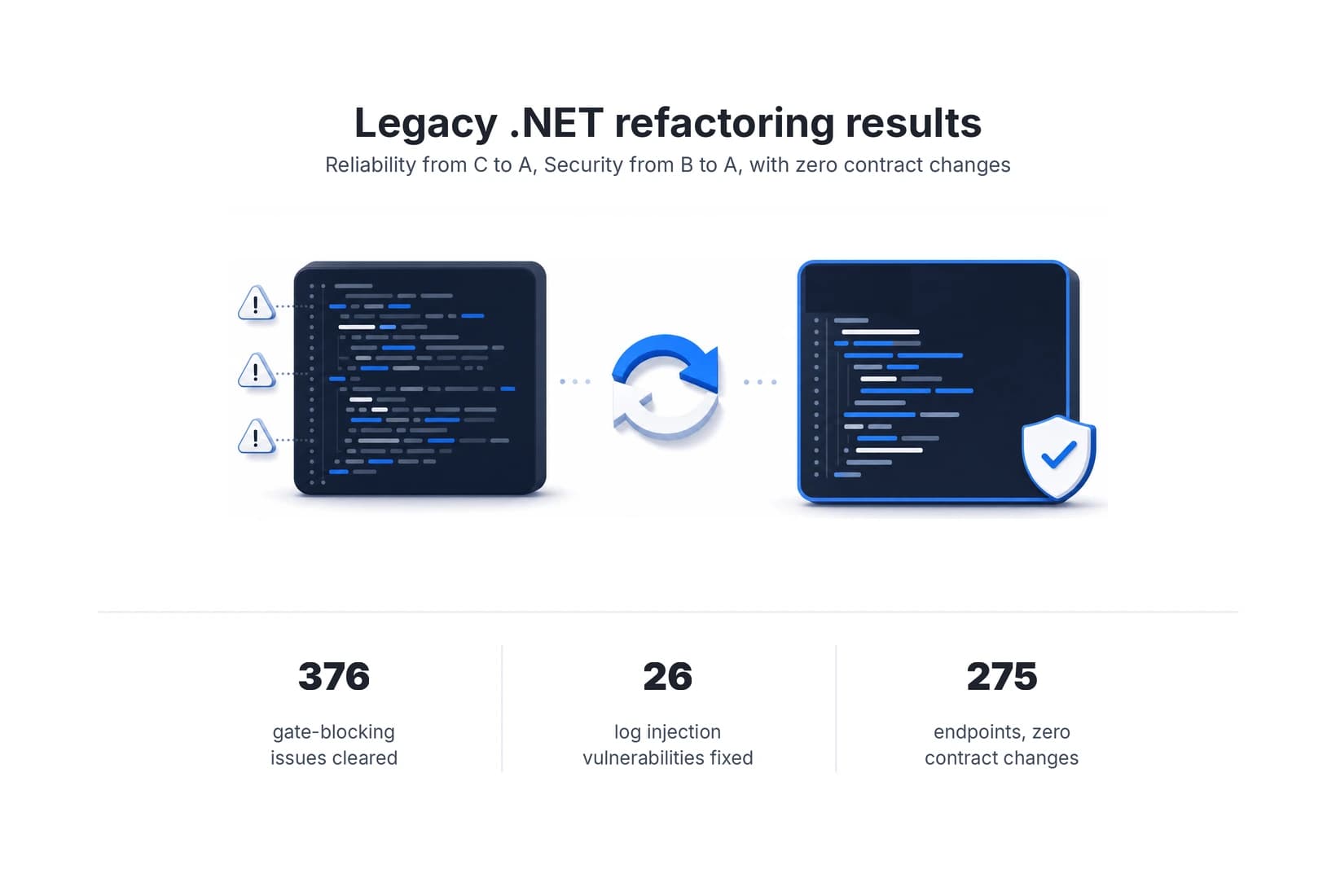
Legacy code refactoring on a live .NET 8 API, with zero contract changes
How AI-native development cleared a blocking SonarQube quality gate and 26 log injection vulnerabilities in a production .NET 8 API, with zero contract changes across all 275 endpoints.