

How to keep code review effective as your team ships more code with AI
As AI raises code volume, the bottleneck moves from writing code to reviewing it. Here is how engineering leaders keep review effective as throughput grows.
 Articles
On this page6 sections
AI does not lower review quality on its own. It raises throughput until review capacity becomes the constraint. This is how to govern review for the new volume.
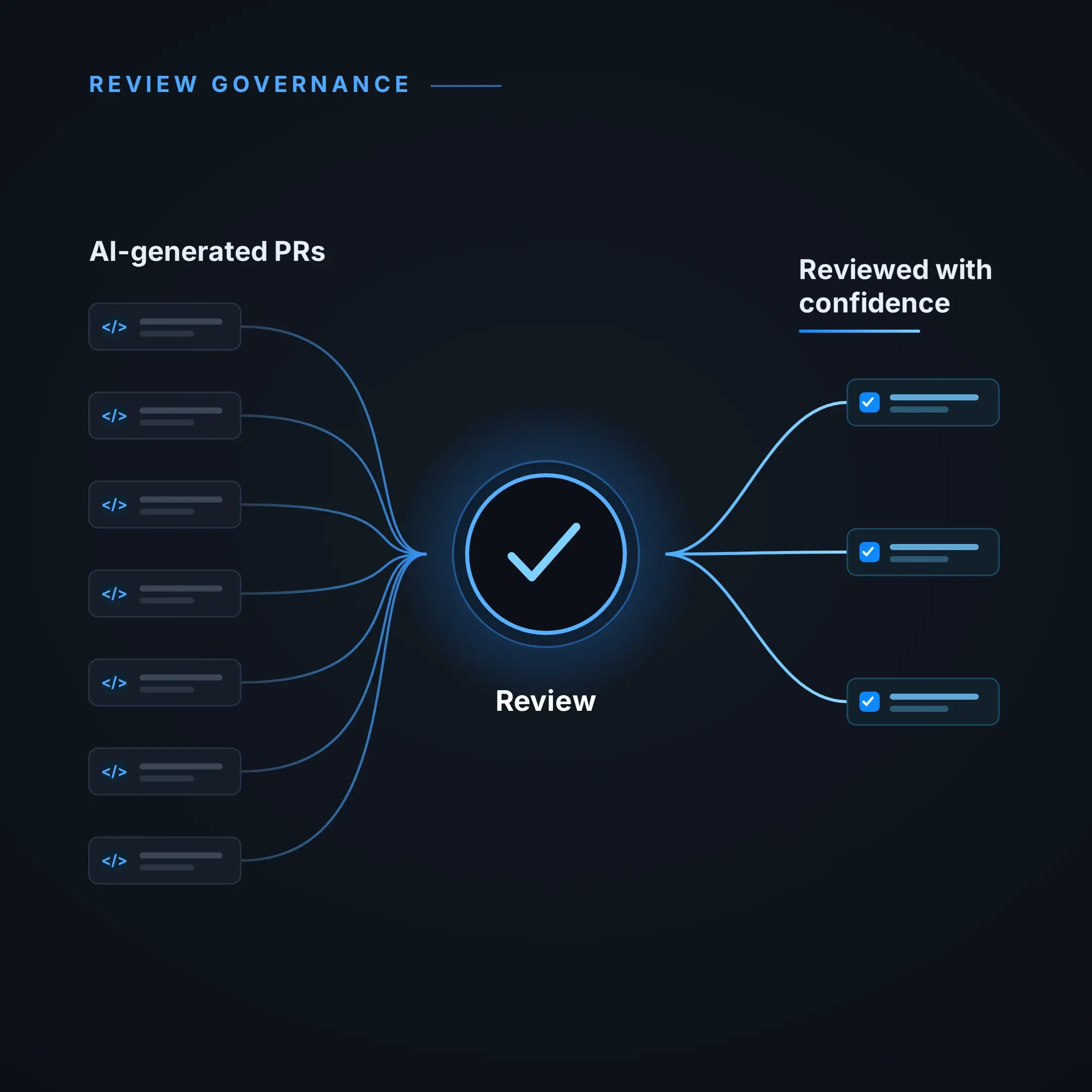
Code review stays effective under AI-assisted volume when the thing you manage is review capacity, not the volume of code itself. AI does not lower review quality on its own. It raises throughput until the review process, and the accountability and validation that make review work, can no longer keep pace. Reliable teams treat review as a system to resource and govern, not a step to speed up.
The review bottleneck moved downstream
AI writes more code, faster. That part works. What most teams underestimate is where the extra volume lands: not in writing, but in everything that happens after a pull request opens.
LinearB's 2026 engineering benchmarks report, built from more than 8.1 million pull requests across 4,800 teams in 42 countries, put numbers on it. Teams with high AI adoption merged 98% more pull requests, but review time rose 91%, and organizational productivity gains settled around 10%. AI-generated pull requests merged at 32.7%, against 84.4% for human-authored ones. The code is generated faster, then waits longer, gets reviewed harder, and merges less often.
The reason is not that AI code is uniformly worse. Part of the merge-rate gap is a selection effect: generating a pull request with AI is cheap, so more exploratory and experimental changes reach the queue than a person would have opened by hand. But the larger reason is structural. Review capacity is fixed while generation is not. A team that adds an AI coding tool doubles the input to a review process that did not change. The queue grows faster than it clears, reviewers triage by avoiding the largest and least-familiar changes first, and the delay compounds. Speed at the keyboard becomes a stall at the merge.
This is the shape of the problem we see across established products. The bottleneck did not disappear when AI arrived. It changed address, from writing code to validating it.
The review governance framework
Keeping review effective is less about a tool and more about whether a handful of things are true of your delivery process. Use these as dimensions to assess your own team, not a score to calculate.
- Review capacity vs merge volume. Weak: reviewers receive whatever the tools generate. Strong: review is resourced to the throughput the team actually produces.
- Pull request size. Weak: large, multi-purpose diffs. Strong: small, single-purpose changes a reviewer can hold in their head.
- Accountability for AI-generated code. Weak: no one can explain why a line is there. Strong: the author owns every line, whether a person or a tool wrote it.
- Test scrutiny. Weak: a green pipeline is treated as proof. Strong: tests are read with the same suspicion as the code, and the load-bearing ones are written by a person.
- Risk-based routing. Weak: every change gets the same review. Strong: higher-risk changes get senior or security review, low-risk changes move quickly.
- Merge gates. Weak: informal sign-off. Strong: defined go and no-go criteria everyone agrees on before merge.
- Escaped-defect measurement. Weak: no one tracks what got through. Strong: the team measures defects that reached production and feeds them back.
None of these require a specific vendor. They require a delivery process where review is designed to absorb AI-assisted volume rather than be buried by it.
What strong review looks like in practice
Two artifacts separate teams that govern review from teams that hope for it.
The first is a short review checklist for AI-generated changes, applied before a diff reaches a human reviewer. Does the change match the stated requirement. Are the APIs and dependencies real rather than plausible-looking. Are error and failure paths handled. Is authorization correct. Do the tests cover the failure case, not just the happy path. The point is not bureaucracy. It is to spend human attention on architecture and correctness instead of catching invented APIs by hand.
The second is a simple decision for what needs deeper review, so the team does not review everything at the same depth. Is the change business-critical? If yes, route it to senior or security review. If not, is it touching shared or high-impact code? If yes, route it to senior review. If not, is it small and well-tested? If yes, standard review is enough.
A team that uses these two artifacts has made review a process rather than an individual habit. A team without them is relying on individual diligence, which does not scale with volume.
Red flags that review has broken under the volume
A pull request approved because continuous integration is green, without anyone reading the change. Automation percentage or test count treated as the main quality signal. No clear owner for the regression suite or the review queue. Pull requests getting steadily larger. No agreed go or no-go criterion for a release. Every bug treated as equally urgent, so nothing is prioritized by risk.
Each of these is a sign that generation has outpaced governance.
Questions to ask your engineering team
- How large is our average pull request, and is it growing?
- Who is accountable for a line of AI-generated code once it merges?
- What is our criterion for merging, and does everyone agree on it?
- Which changes get deeper review, and how do we decide?
- Do we measure defects that reach production, and do they change how we review?
If the answers are unclear, the constraint is not your tools. It is how your review process is resourced and governed.
What disciplined engineering produces
The payoff of treating review and validation as a system is measurable reliability, not abstract quality. On a recent Android application with more than a million downloads, we analyzed the primary causes of instability, prioritized the issues with the greatest user impact, and validated targeted fixes. The user-perceived crash rate fell from 0.54% to 0.36%, about 33% lower. The ANR rate fell from 0.84% to 0.26%, about 69% lower.
The lesson is not a specific tool or a single test. It is that disciplined engineering plus targeted validation moves the metrics users actually feel. That same discipline is what review governance protects when AI raises the volume of code moving through your pipeline.
AI will keep raising how much code your team can produce. Whether that becomes reliable delivery or a growing review backlog depends on the system around it. We build software with review, QA, and delivery visibility built into the process, so faster generation becomes dependable software rather than faster rework.
Keep reading
All resources Case study
Making an AI product reliable enough to ship: a QA and evaluation case
Generating AI ratings was the easy part. Making them reliable enough to ship took a continuous evaluation and QA loop, validated with real users before launch.
 Articles
What AI changed about how we evaluate engineers
A founder's account of how five years of AI changed what NetForemost looks for in an engineer, from output to judgment, and why that shift moves the whole delivery bottleneck.
 Case study
Mobile app onboarding redesign case study
An instrumented onboarding rebuild lifted a mobile app's sign-up completion from 48 to 70 per 100, and the same measurement showed where the real bottleneck was.