

From discovery to SOW: how to turn uncertainty into a clear delivery plan
A framework for converting discovery notes, risks, user needs, and technical assumptions into a clear software delivery plan.
 Guide
GuideOn this page5 sections
Why discovery exists
Most projects do not start with a complete, shared understanding. Stakeholders may agree on the headline while holding different assumptions about users, priorities, integrations, deadlines, or what "done" means. Starting development at that point turns engineers into expensive assumption-testers.
- Reduce uncertainty by making unanswered product and technical questions visible.
- Validate assumptions with stakeholders, users, and the existing system before they shape the build.
- Identify delivery, security, compliance, integration, and ownership risks early.
- Improve estimates by tying effort to a prioritized scope and named dependencies.
The hours saved by discovery are rarely writing hours. They are the hundreds of hours a team never spends implementing, reviewing, testing, and unwinding the wrong thing.
Ana Soto · Head of Discovery
What happens during discovery
Align on business outcomes
Stakeholder interviews establish the problem, the expected business change, success measures, constraints, and the cost of delay.
Understand users and journeys
The team reviews existing research, user pain points, accessibility needs, and the flows the product must support.
Prioritize the product
Features are separated into the smallest valuable release, later increments, and ideas that are explicitly out of scope.
Assess the technical landscape
Engineers review the codebase, architecture, hosting, integrations, security, compliance, data, and operational dependencies.
Map risk and delivery
Unknowns receive owners and mitigation plans. Milestones, sequencing, team shape, communication cadence, and decision paths are defined.
The deliverables you should expect
A discovery engagement is only as useful as what it leaves behind. Each artifact below answers a specific question the SOW will later depend on — together they are the difference between an estimate and a plan.
Product vision
A one-page statement connecting the proposed work to a measurable business outcome, so every later scope decision can be checked against "does this serve the vision?"
Requirements
The functional and non-functional needs the product must satisfy — written specifically enough that two engineers would build the same thing from them.
User stories
Requirements reframed around real user goals and acceptance criteria, so QA and design know what "working" means before a single screen is built.
Prioritized backlog
Every requirement and story ranked against the business outcome, separating the first valuable release from later increments and explicit non-goals.
Wireframes
Low-fidelity flows for the screens and interactions where words alone leave room for interpretation — cheap to change now, expensive to change after development starts.
Architecture
Recommendations covering systems, integrations, data, security, and hosting, validated by a technical owner rather than assumed by the estimate.
Timeline
A milestone plan with dependencies and decision points, sequenced against the prioritized backlog and the team's actual capacity.
Risks
A register naming probability, impact, owner, and mitigation for each material risk, so nothing material is discovered for the first time mid-sprint.
Cost estimate
A price range tied explicitly to the scope and assumptions above, so a change in either has a visible, defensible effect on the number.
How discovery becomes a Statement of Work
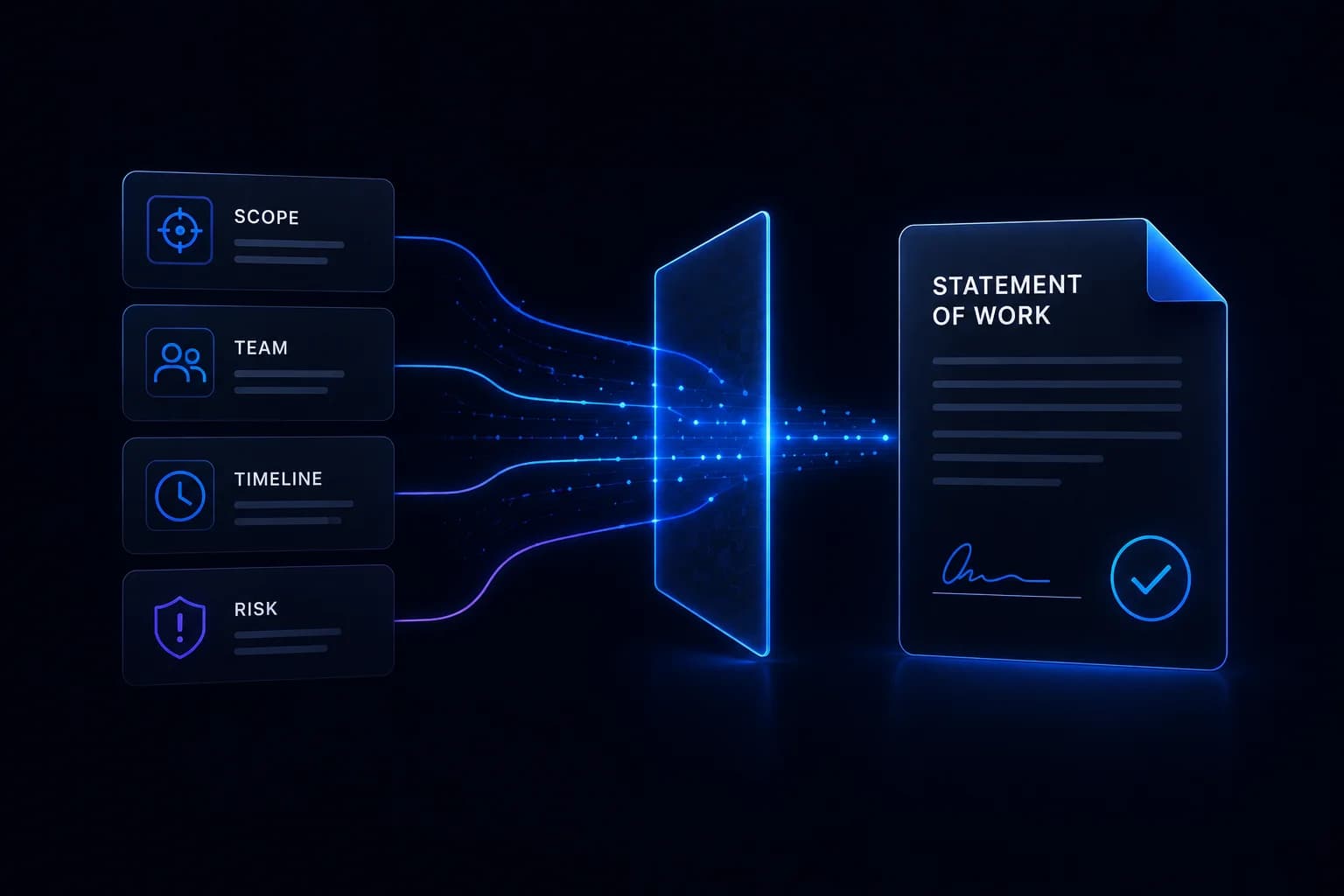
A strong SOW is a compressed version of the discovery evidence, not a separate negotiation. Each of the following is informed directly by an artifact above:
- Scope — the prioritized backlog becomes the included work, stated in plain language.
- Assumptions — anything discovery could not fully validate is named explicitly rather than implied.
- Milestones — the timeline's dependencies and decision points become the delivery sequence.
- Deliverables — wireframes, architecture, and requirements define what "delivered" concretely looks like.
- Acceptance criteria — user stories and success measures become the test for whether work is accepted.
- Pricing — the cost estimate's assumptions become the terms under which the price holds.
- Timeline — the milestone plan becomes the dates both sides are committing to.
- Responsibilities — decision paths and ownership from discovery become the engagement model, naming who owns what on each side.
Scope
Included work and explicit exclusions
Proof
Acceptance criteria tied to outcomes
Ownership
Named client and partner responsibilities
Common mistakes that erase the value
- Skipping discovery and treating the first estimate as a commitment.
- Rushing to a single date or price while important assumptions remain unnamed.
- Inviting only technical stakeholders and discovering business disagreement after development starts.
- Approving priorities without recording what was deprioritized and why.
- Treating the discovery report as a handoff document instead of the source material for the SOW.
Keep reading
All resources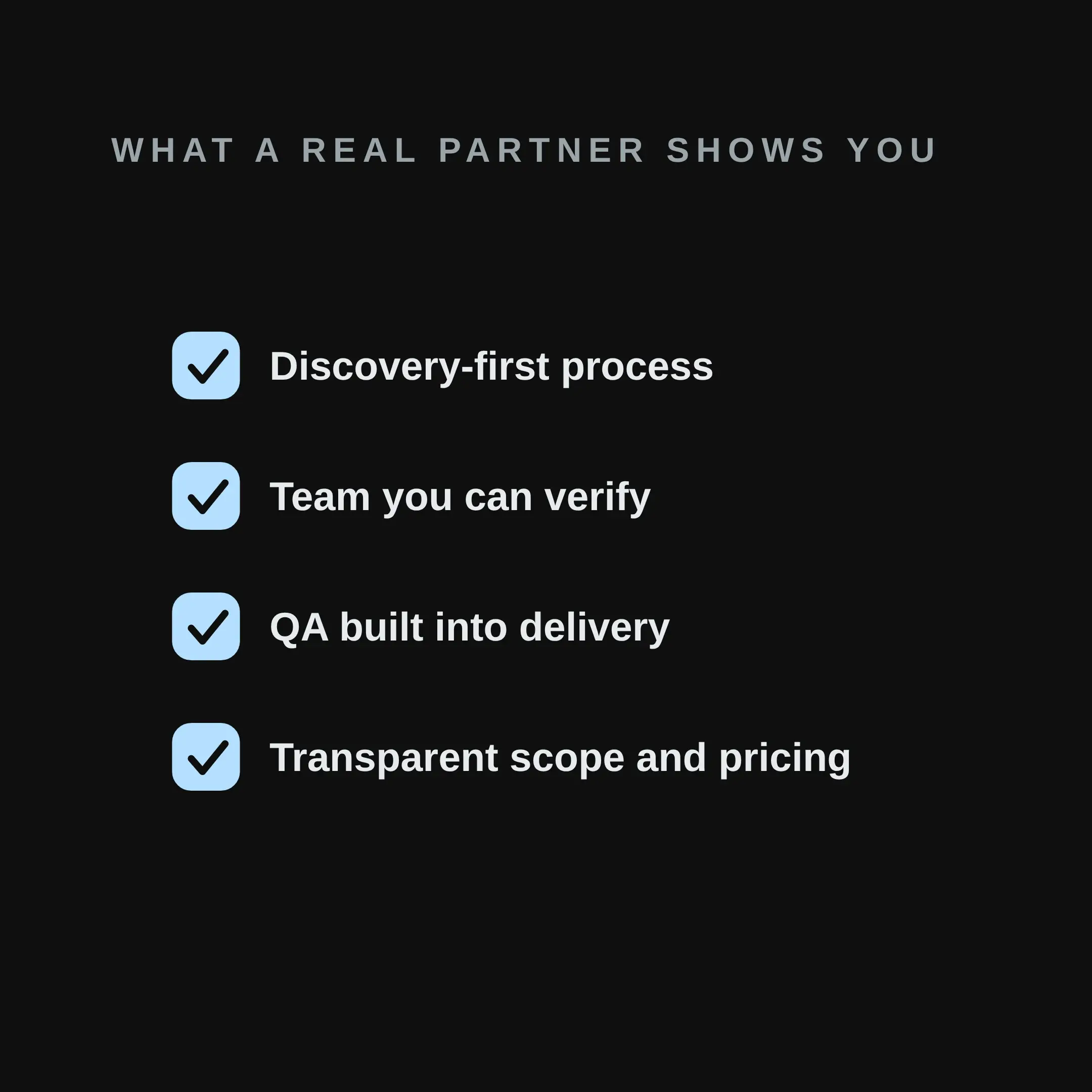 Articles
How to choose custom software development services
What custom software development services include, how discovery reveals a real partner, the engagement models, and the questions to ask before you sign.
 Articles
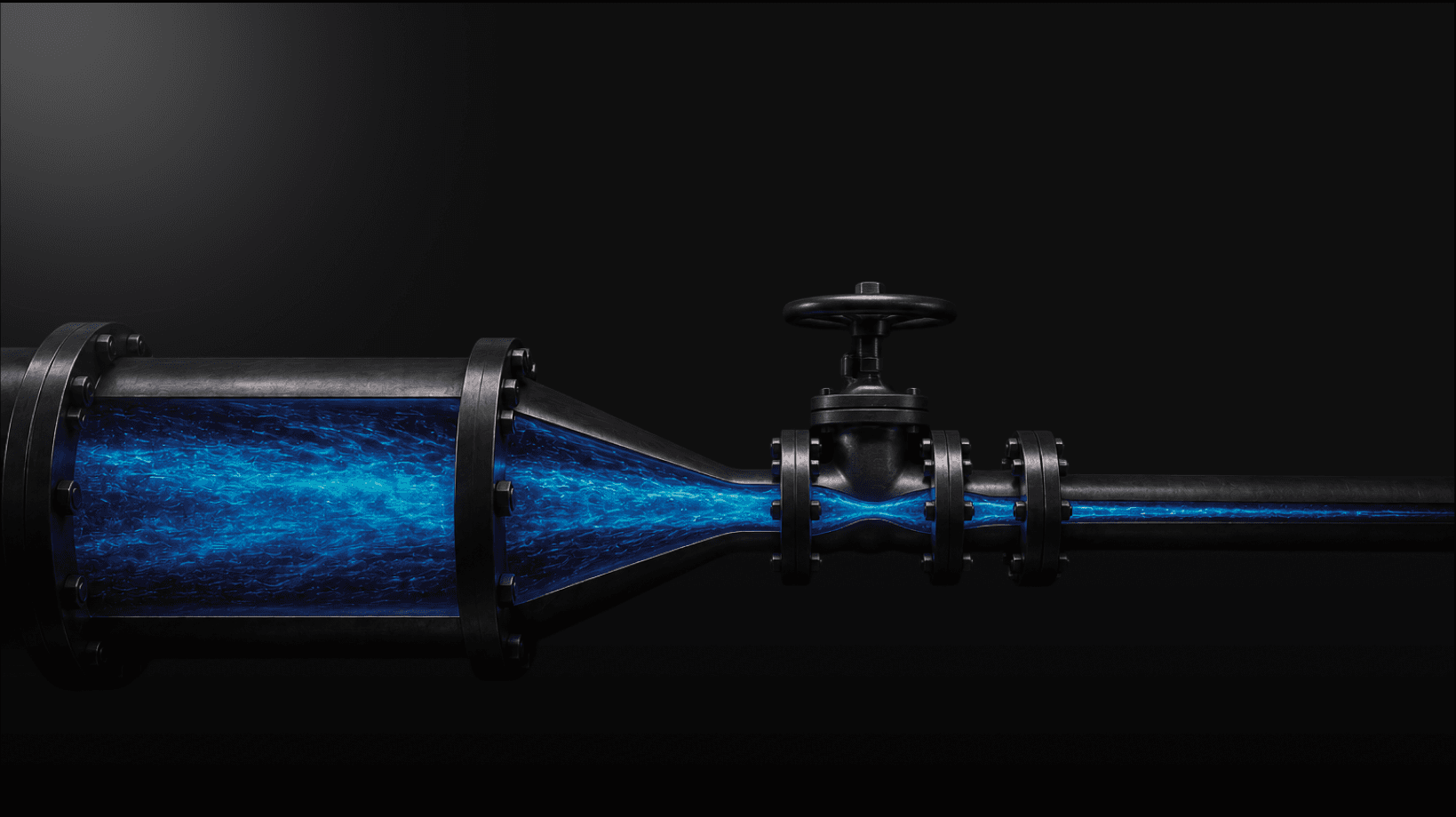
The bottleneck didn't disappear. It just changed its address.
AI made engineers faster — but throughput on the main branch is falling. Three tool launches in two weeks reveal where the bottleneck actually moved, and what it means for teams adopting AI coding agents.
 Guide
GuideDiscovery checklist: 24 questions before you sign a SOW
24 questions grouped into five areas, goals, risks, ownership, success criteria, and delivery assumptions, to align on before signing a statement of work.