

The AI-native delivery playbook for software teams
AI-native delivery is not AI everywhere. It is knowing exactly where AI creates leverage and where a human still has to own the decision.
 Guide
GuideOn this page10 sections
AI can accelerate your delivery. It can just as easily accelerate your assumptions. Here is how to tell the difference before it costs you.
AI can accelerate software delivery. It can also accelerate assumptions. The difference is whether a human still owns the decision at each critical checkpoint. AI-native delivery is not about using AI at every step. It is about deciding, deliberately, where AI creates leverage and where a human still has to own the decision.
Where AI actually helps in delivery
AI creates real leverage across four parts of the delivery cycle, and each one has a different failure mode if a human stops paying attention.
Discovery
AI can surface patterns and open questions across stakeholder input, prior documentation, and codebase context. It cannot decide which trade-offs the business should accept. That is analysis capacity, not decision authority, and the two are not the same thing.
Planning
AI can draft a first-pass breakdown of a feature into tasks, estimate rough complexity, and flag likely dependencies. It has no visibility into actual team capacity, competing priorities, or the unwritten constraints a senior engineer already carries. Planning still needs a human to adjust the draft against reality.
QA
AI can generate test cases, catch obvious regressions, and check code against known patterns faster than manual review alone. It can pass code that is technically correct and still wrong for the user. Technical correctness is not product correctness.
Communication
AI can summarize a thread, draft a status update, or translate technical detail for a non-technical stakeholder. The risk is not that the summary loses nuance. It is that the summary becomes the new source of truth without anyone validating whether it preserved the original decision.
Why the failure mode is not bad code
The risk in AI-assisted delivery is rarely a single obviously broken feature. It is a slow drift: assumptions nobody validated, a plan nobody adjusted for the team's real capacity, test coverage that looks complete but was never checked against the actual requirement, and decisions that got summarized so many times the reasoning behind them disappeared. Each step looks fine in isolation. The cumulative effect is a delivery process that moves fast and loses track of why it is moving.
The operating principle
AI can draft, generate, and summarize. Humans decide, verify, and confirm. That is the operating principle: document assumptions and risks as they come up, not after something breaks.
None of this asks a team to slow down. It asks a team to be explicit about which parts of the process AI is allowed to drive, and which parts still require a person to sign off. Teams that skip this distinction tend to discover it the expensive way, when a plan built on an AI-drafted assumption ships and the assumption turns out to be wrong.
What this looks like week to week
A team applying this well can point to specific habits: every AI-drafted plan gets reviewed against actual team capacity before it becomes a commitment. Every AI-generated test suite gets checked against the original requirement, not just against the code it was generated from. Every AI-summarized decision that affects more than one person gets confirmed by someone who was in the original conversation. None of these add much time. They add a checkpoint where a human either agrees or corrects course, before the work moves downstream.
The closed loop behind the checkpoints
Diana Hu, a YC partner, describes AI-native companies through the idea of the closed loop: instead of letting decisions and outcomes disappear into an open-ended process, teams capture what happens so the system can learn from it and improve.
Her framework was built for early-stage companies starting from zero. For software delivery, the transferable idea is simpler: work that is legible and queryable is easier to review, reuse and improve.
Applied to delivery, every stage leaves a traceable record: what was decided, what was built, what was reviewed, what was tested, what shipped and why. In practice, acceptance criteria are defined before code starts, not reconstructed after a bug appears. QA and review are part of delivery from day one, not a final gate. And ownership stays visible: who approved what, based on which evidence, so a founder or CTO can inspect it without reconstructing the story from Slack messages, tickets and memory.
This is also why the checkpoints above matter more as AI speeds up generation. Faster output puts more pressure on review and QA, and a closed loop keeps that pressure visible instead of silent.
Questions to ask your own delivery process
- Which parts of our process currently let AI output move forward without a human sign-off?
- When a plan or test suite comes from AI, who is responsible for checking it against the real requirement?
- If an assumption behind a current sprint turned out to be wrong, would we catch it before or after it ships?
- How much of what the team knows about a decision lives only in an AI-generated summary?
- Could someone outside engineering understand what shipped last month, what was validated and who approved it?
AI-native delivery is not a tool you install. It is the discipline of keeping a human accountable at each of these checkpoints while AI does the part it is actually good at: producing volume, faster, so people can spend their attention on judgment instead of typing.
AI gives teams more leverage. Ownership determines whether that leverage produces better software or just faster output.
At NetForemost, our AI-native approach combines AI-assisted delivery with human review at the points where judgment still matters most.
Keep reading
All resources Articles
What AI changed about how we evaluate engineers
A founder's account of how five years of AI changed what NetForemost looks for in an engineer, from output to judgment, and why that shift moves the whole delivery bottleneck.
 Case study
Health and Wellness Mobile App Development Case Study
When a client's input slows down in the middle of a project, delivery does not have to stall.
 Case study
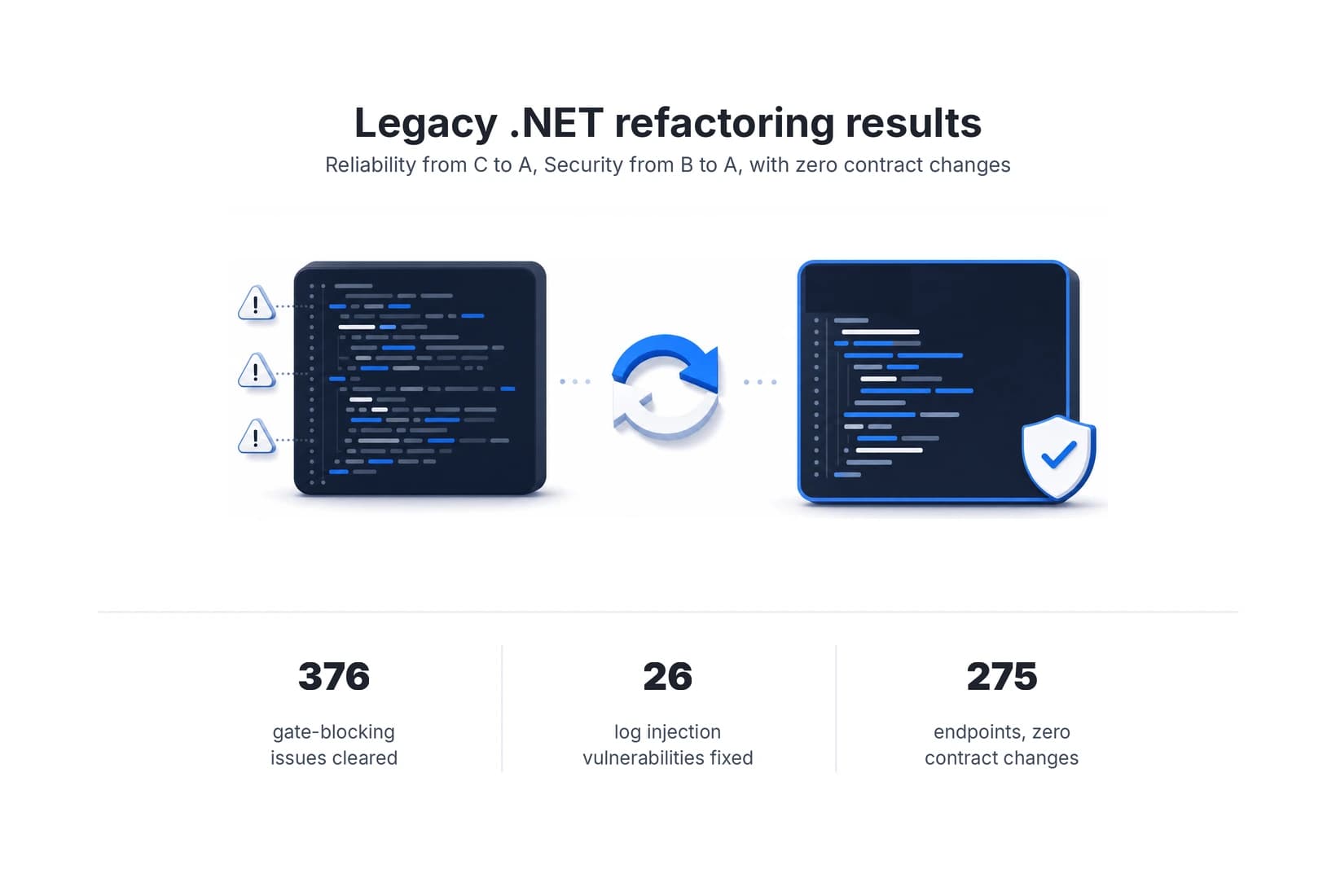
Legacy code refactoring on a live .NET 8 API, with zero contract changes
How AI-native development cleared a blocking SonarQube quality gate and 26 log injection vulnerabilities in a production .NET 8 API, with zero contract changes across all 275 endpoints.