

QA as a service vs in-house vs staff augmentation: how to choose
A build-vs-buy framework for choosing between QA as a service, in-house QA, and staff augmentation, plus a readiness score, red flags, and questions to ask before you commit.
 Articles
On this page14 sections
- QA as a service vs in-house QA vs staff augmentation
- In-house QA
- Staff augmentation
- QA as a service
- How to choose
- Cost structure, not price
- The NetForemost build-vs-buy readiness score
- How to score it
- Score bands
- What an external QA capability looks like in practice
- Stability owned across the team
- Red flags once you have chosen a QA as a service partner
- Questions to ask before you sign
- The bottom line
The three models solve different problems. Picking the wrong one usually shows up first in slipping release quality.
The question to ask first is not which QA model costs less. It is what you are actually buying: more hands under your own process, a full internal capability you build and keep, or an external team that owns an agreed QA process for you. QA as a service, staff augmentation, and in-house QA each answer a different one of those three asks, and the rest of this guide gives you a way to tell which one your product needs right now.
Get the model wrong and it rarely fails loudly. It shows up as releases that slip on quality, a regression suite nobody quite owns, or a QA hire that never fully ramps before priorities shift again. This guide compares how the three models work, where the cost actually sits in each one, and gives you a scorecard to size your own readiness before you choose.
QA as a service vs in-house QA vs staff augmentation
All three aim at the same outcome: software that ships without quality surprises. Where they differ is how much of the QA process you want to own, how fast you need coverage in place, and how much your product depends on deep, built-up domain knowledge.
In-house QA
In-house QA tends to fit when quality is a long-term capability you want to own directly, and when your product sits in a domain or regulatory context that rewards deep knowledge built over years. You get the highest direct control and the deepest product context. You also carry the fixed overhead: salaries, recruiting, management, tooling, and idle capacity between testing peaks.
Staff augmentation
Staff augmentation tends to fit when you already have QA leadership and a working process, and the gap is execution capacity, not direction. You keep ownership of the process, prioritization, and release decisions. The external engineers add hands. If the underlying process is weak, more hands will not fix it, they will just run it faster.
QA as a service
QA as a service tends to fit when you need an established QA capability and process, not just more testers, and building and managing that team yourself is not where you want to spend the next two quarters. Capacity flexes with delivery instead of sitting fixed on a headcount plan. The trade-off is that you are integrating an external team into your delivery, so choosing a provider that brings a real, defined process matters more than the rate card.
How to choose
Reduced to one line each:
- Choose in-house when QA is a long-term internal capability and deep domain knowledge matters most.
- Choose staff augmentation when you already own the QA process and leadership, and only need more execution capacity.
- Choose QA as a service when you need the capability and the process, not just additional testers.
Cost structure, not price
There is no universally cheaper model, and rates vary too much by country, seniority, and scope to compare directly. What is useful is seeing where the cost actually sits in each one.
- In-house: salaries and benefits, recruiting, management overhead, tooling, onboarding and ramp time, and idle capacity between peaks.
- Staff augmentation: contractor capacity, plus your own QA leadership and process ownership, tooling, and the effort of scaling up or down.
- QA as a service: a service fee, onboarding and integration, scope or capacity changes, and your own internal product ownership.
In-house concentrates cost in fixed overhead you carry whether or not you are in a testing peak. The other two convert more of that cost into variable capacity, in exchange for some direct control.
The NetForemost build-vs-buy readiness score
Most comparisons stop at when each model fits. This turns that into a score. Rate your own team on the five criteria below, weight the results, and the total tells you whether you are set up to own QA internally or better served buying the capability.
- Process maturity today (25%). Weak: no documented process, or one that changes release to release. Average: a process exists but leans on a few people to hold it together. Strong: a mature process followed the same way every release, regardless of who is testing.
- Hiring runway (20%). Weak: quality is slipping now and a new hire will not ramp in time. Average: some runway, but tight against the roadmap. Strong: enough time to recruit, onboard, and ramp a team properly.
- Domain and regulatory depth (20%). Weak: a general product with no deep domain or compliance knowledge required. Average: some domain nuance, but nothing regulator-facing. Strong: a regulated, safety-critical, or deeply technical domain that takes years to learn.
- Demand stability (20%). Weak: testing volume swings hard from release to release. Average: some seasonality, but broadly predictable. Strong: a steady, predictable testing load across the year.
- Strategic differentiation (15%). Weak: QA quality is not something customers evaluate you on. Average: QA quality matters to customers but is not the product itself. Strong: QA is a defensible, sellable part of what you offer.
How to score it
Rate each criterion weak (1), average (3), or strong (5). Multiply each score by its weight, add the results, and multiply by 20 for a final score from 20 to 100.
Score bands
Use these ranges as a practical benchmark, not an industry standard:
- 80 to 100: you are set up to own QA in-house.
- 60 to 79: staff augmentation likely fits, since you already own the process.
- Below 60: QA as a service is the faster, lower-risk path to a mature capability.
A low score is not a verdict on your team. It usually means the process, the runway, or the demand pattern is not there yet, and buying the capability closes that gap faster than building one from scratch.
What an external QA capability looks like in practice
Look for evidence of outcomes and ownership, not just testing activity.
Stability owned across the team
On one Android product, QA and engineering worked from the same backlog throughout delivery instead of QA testing a finished build at the end. The user-perceived crash rate fell about 33%, from 0.54% to 0.36%, and the ANR rate fell about 69%, from 0.84% to 0.26%. What to notice: regression ownership carried across releases, not a testing pass added at the end.
Red flags once you have chosen a QA as a service partner
If you land on QA as a service, these signals tell you whether the provider brings a real process or just testers for hire:
- The vendor talks about the number of test cases rather than release risk.
- QA only joins after development is complete.
- No clear owner for regression-suite maintenance.
- They cannot show a sample test plan or explain their go or no-go criteria.
- Automated tests run as a separate silo instead of inside the delivery pipeline.
- Every bug is treated with the same priority.
- The pitch is testers for hire, with no process behind them.
Questions to ask before you sign
Whichever model you land on, these questions surface whether the engagement is actually structured or just staffed:
- What is the scope, and what are the release gates, defined before work starts?
- What are the SLAs on turnaround and on how severity is handled?
- What access and onboarding will the team get into the product context?
- Who owns regression-suite maintenance, and is it maintained every release?
- What gets reported: release risk, or raw bug counts?
- Who is the named lead accountable for your product?
The bottom line
QA as a service is not outsourced testing with a new name. It is an external team owning an agreed process, integrated into delivery, in exchange for giving up some direct control. In-house wins when control and deep domain knowledge matter most. Staff augmentation wins when you already own the process and only need hands.
Keep reading
All resources Case study
Health and Wellness Mobile App Development Case Study
When a client's input slows down in the middle of a project, delivery does not have to stall.
 Case study
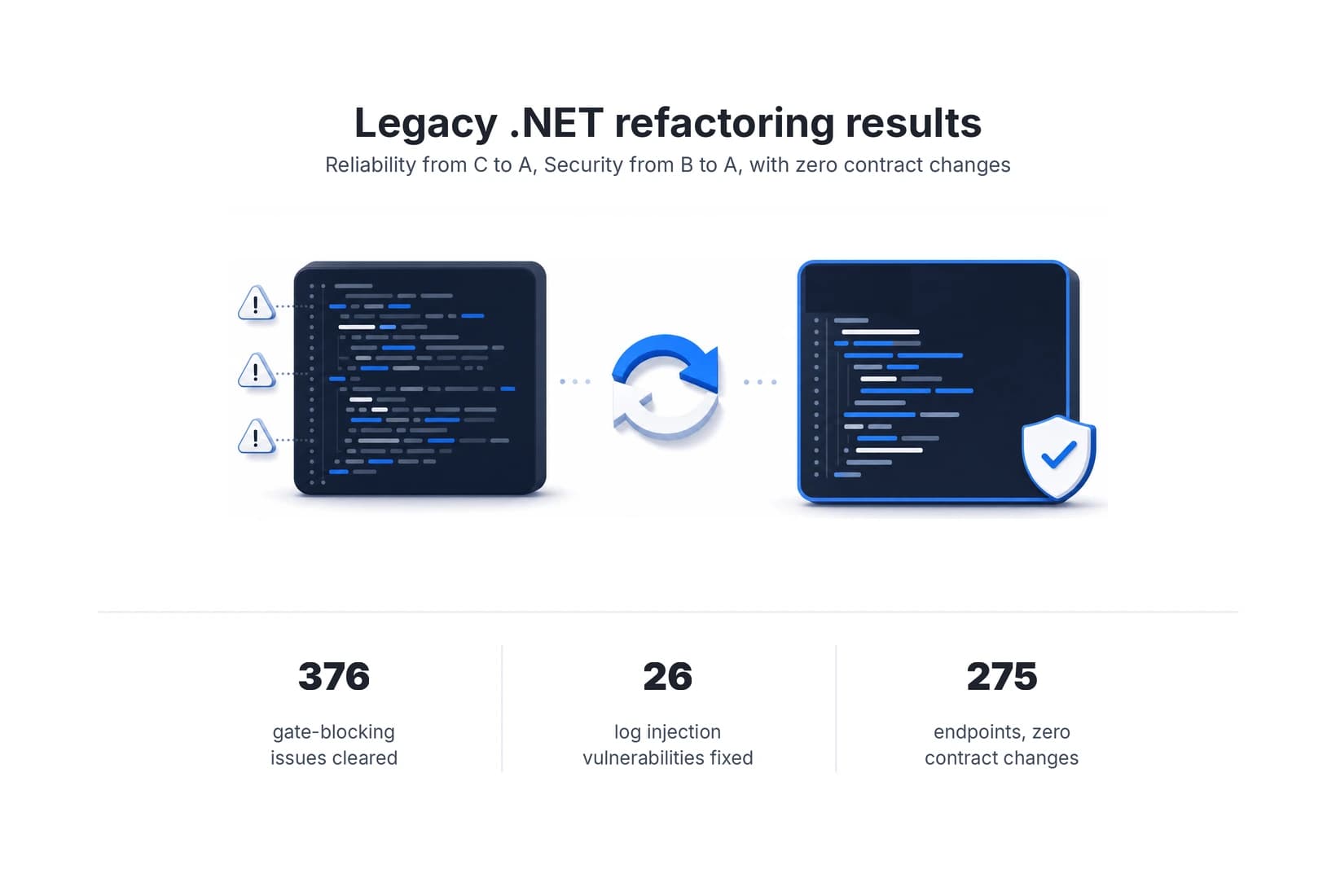
Legacy code refactoring on a live .NET 8 API, with zero contract changes
How AI-native development cleared a blocking SonarQube quality gate and 26 log injection vulnerabilities in a production .NET 8 API, with zero contract changes across all 275 endpoints.
 Articles
How to evaluate QA testing services: a vendor selection guide
The criteria that separate real QA partners from checkpoint vendors, plus a scorecard to rate them, red flags to watch for, and the questions to ask before you sign.